


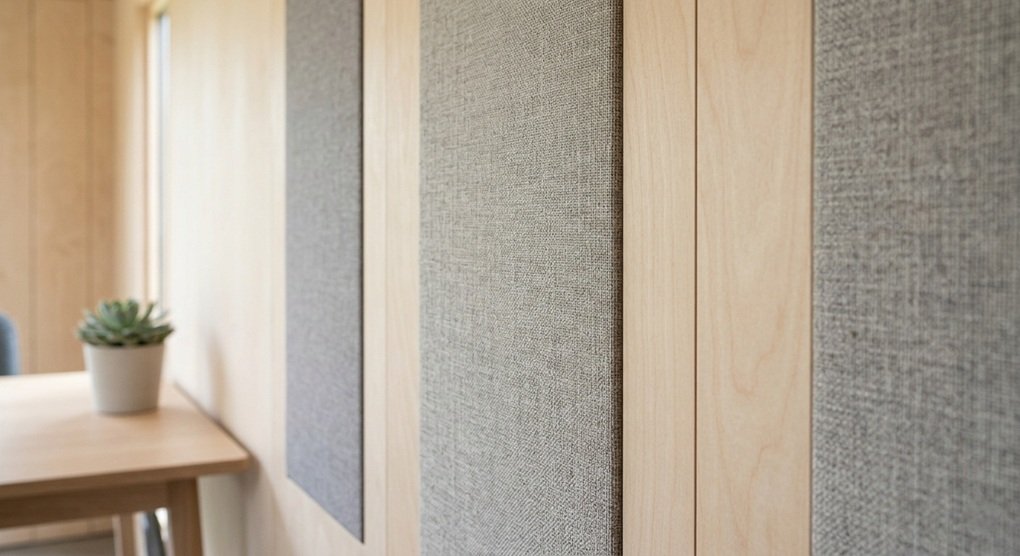
Commercial-Grade Acoustic Panels for Timber Outbuildings
There is a distinct moment of dread known to every remote professional: you are presenting to a major client or leading a board meeting when your neighbour chooses that exact moment to fire up a petrol lawnmower. Or perhaps the delivery driver arrives, sending the family dog into a barking frenzy just meters from your desk. While a timber garden studio provides a magnificent physical boundary between your home and your work life, standard timber structures are naturally lightweight, meaning they often struggle to block out the intrusive, low-frequency hums of suburban life.
To achieve true executive focus and pristine audio quality during critical calls, investing in high-end, commercial-grade acoustic treatments is essential. Let’s evaluate the performance, aesthetics, and practical realities of integrating professional architectural acoustic panels into a modern garden studio.
Soundproofing vs. Sound Absorption: Knowing the Difference
Before investing in acoustic modifications, it is vital to understand that tackling noise requires two completely different architectural approaches.
- Soundproofing (Mass and Isolation): This prevents external sound from entering your studio. It requires heavy, dense materials (such as dense acoustic plasterboard, mass-loaded vinyl, or decoupled “room-within-a-room” timber framing) built directly into the walls during construction.
- Sound Absorption (Acoustic Panels): This controls how sound behaves inside your room. If your studio features minimalist hard surfaces like engineered wood flooring, large glass desks, and expansive windows, your voice will bounce around, creating echo, reverberation, and listener fatigue on video calls. Acoustic panels soak up these internal reflections, making your audio sound crisp, deep, and completely professional.
Architectural Options: Wood Slats vs. Fabric-Wrapped Panels
When specifying premium acoustic treatments that complement a minimalist, architectural magazine aesthetic, two primary options dominate the UK market.
Premium Wood-Slat Panels (e.g., Oak Veneer on Felt Backing)
These panels feature vertical timber slats mounted over a thick layer of compressed recycled felt, creating a striking contemporary feature wall.
- Pros:
- Exceptional architectural aesthetic that adds organic warmth, texture, and depth to a minimalist cedar pod interior.
- Incredibly easy to install as a straightforward weekend project using standard grab adhesive or black screws.
- Highly effective at diffusing mid-to-high frequency sounds, which instantly eliminates that hollow “empty room” echo when speaking.
- Cons:
- They do not absorb deep, low-frequency bass notes (like passing traffic or heavy lawnmowers) because the panel lacks dense mass.
- They cannot be easily installed directly behind radiators or direct heat sources without risking warping to the natural wood veneer over time.
Commercial Fabric-Wrapped Broadband Absorbers (e.g., Core Mineral Wool Panels)
These are geometric, fabric-clad panels engineered with rigid, high-density acoustic mineral wool cores enclosed within solid internal frames.
- Pros:
- Superior technical performance, acting as broadband absorbers that handle a much wider range of sound frequencies.
- Can be customized in an array of high-end, interior-designed textiles (such as premium British wools) to look like high-end geometric wall art.
- Formaldehyde-free core options ensure that the air quality inside a sealed, compact timber room remains perfectly healthy.
- Cons:
- They possess a more functional, corporate studio appearance compared to the striking, natural flow of continuous timber slatted walls.
- They take up physical space, jutting out slightly from the wall surface due to the thickness required for deep sound absorption.
The Verdict and Placement Strategy
To transform your garden office into an acoustic sanctuary, you do not need to cover every square inch of your timber cladding. A targeted, strategic deployment yields the highest performance return.
For the ultimate executive setup, focus your panel placement directly on the “first reflection points.” This means mounting a beautiful segment of wood-slat or premium fabric panels on the wall directly behind your monitors, and another array on the wall behind your seat. This layout ensures that your voice travels past your microphone, hits an absorbing surface, and dies quietly—leaving your clients with crystal-clear, studio-grade audio that feels completely disconnected from the chaotic domestic world outside.