


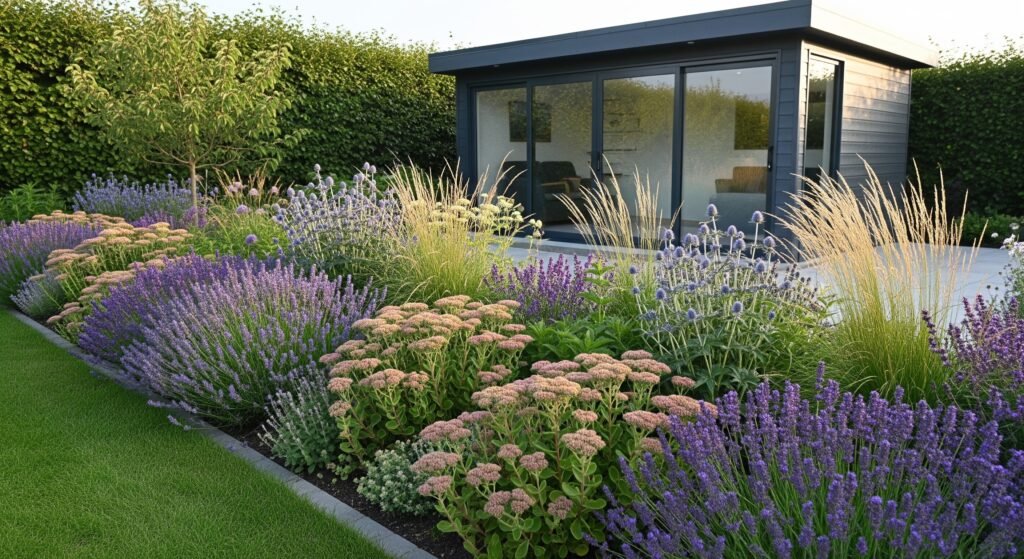
Designing the Garden Office Border for Extreme UK Weather
Landscaping the immediate vicinity of the office to cope with increasingly variable UK weather patterns. This covers selecting drought-tolerant plants for summer heat, managing drainage during heavy rainfall, and choosing robust specimens to withstand strong winds and unexpected frost.
Resilient Office Landscaping: A Guide to Thriving in Variable UK Weather
Coping with the Challenges of a Changing Climate
The contemporary UK weather landscape is defined by its increasing variability, presenting unique challenges for maintaining attractive and functional office surroundings. Successful landscaping in the immediate vicinity of a corporate building now requires a forward-thinking, resilient approach that anticipates and mitigates the effects of extreme weather events, from summer heatwaves and prolonged drought to torrential downpours, high winds, and unexpected late frosts.1. Drought Tolerance and Summer Heat Management
As summer temperatures rise and dry spells become more frequent and extended, selecting the right flora is paramount to minimising maintenance and water consumption.
- Plant Selection: Focus on xeriscaping principles. Choose indigenous or non-native, drought-tolerant species that have naturally adapted to dry conditions. Examples include lavender (Lavandula), sedums, ornamental grasses like Stipa and Calamagrostis, and certain Mediterranean-climate shrubs such as rosemary (Salvia rosmarinus) and Cistus (Rock Rose).
- Soil Improvement: Incorporate organic matter (e.g., well-rotted compost) into planting beds. This improves the soil’s structure, allowing it to hold moisture more effectively deep down while preventing rapid surface evaporation.
- Mulching: Apply a thick layer (5-10cm) of organic mulch, such as wood chippings or bark, around all plantings. Mulch dramatically reduces water evaporation, keeps roots cooler, suppresses weed growth, and slowly releases nutrients back into the soil.
2. Managing Drainage and Heavy Rainfall
Increased frequency of intense rainfall requires robust drainage strategies to prevent waterlogging, soil erosion, and potential damage to the building’s foundations or pathways.
- Ground Preparation: Ensure that soil around the office has adequate slopes (grades) to direct surface water away from the building. Avoid creating sunken planting beds that act as water traps.
- Installation of Permeable Surfaces: Replace impermeable concrete or tarmac paths and parking areas with permeable alternatives like gravel, porous paving, or reinforced grass pavers. These materials allow rainwater to filter through to the soil and sub-base, reducing runoff into storm drains.
- Rain Gardens and Swales: Integrate rain gardens—depressions planted with water-loving native species—into the landscape. These features temporarily hold and filter runoff water, allowing it to slowly soak into the ground. Similarly, shallow channels called swales can be used to manage and redirect large volumes of surface water.
3. Wind and Frost Resilience
Robustness is key to ensuring that landscaping retains its visual integrity and structural health against strong winds and unpredictable periods of low temperature.
- Wind Resistance: Select robust specimens with sturdy root systems and flexible stems. Avoid tall, top-heavy trees or shrubs, which are prone to uprooting or snapping. In exposed locations, consider planting dense, low-growing shrubs or installing semi-permeable screening (e.g., hedges or slatted fences) to filter the wind rather than creating harsh turbulence.
- Anchoring and Staking: For newly planted trees, use secure, low staking methods that allow for some natural movement, encouraging the development of strong, flexible wood and a robust root collar. Remove stakes promptly once the tree is established (typically after one growing season).
Frost Protection: Choose fully hardy plants appropriate for the local hardiness zone. Be wary of planting tender species in microclimates where frost pockets may form (e.g., low-lying areas). For high-value, semi-hardy plants, have burlap or horticultural fleece on hand for temporary protection during unexpected severe frost events.