


Date: 22 January 2025
The Blackwell Beast in a Box: A Generational Leap with a Thermal Problem
Fresh from the buzz of CES 2025 in Las Vegas, the Nvidia GeForce RTX 5080 and its monstrous sibling, the 5090, powered by the new Blackwell architecture, have finally made their landing on UK tech shelves. This isn’t just an incremental upgrade; for the committed garden-based video editors, complex 3D modellers, and cutting-edge AI researchers, these cards represent a legitimate, generational leap in processing power.
The raw uplift in CUDA cores and the introduction of faster GDDR7 VRAM translate directly into tangible performance gains: rendering times are slashed, and local, intensive AI model training becomes genuinely viable outside of a corporate data centre. However, this immense power comes with a significant and often overlooked caveat for the garden commuter:
Heat Density.
A standard 3m x 3m timber garden office is a marvel of modern micro-architecture. Built to be a year-round workspace, these pods are typically incredibly well-insulated, often boasting U-values of $0.18 W/m^2K$ or better. While this superb insulation is your best friend during a frosty winter morning, keeping the heat in, it quickly becomes your worst enemy when housing high-end silicon. The 400W–500W of waste heat generated by an RTX 5090 under sustained load is not a minor inconvenience; it’s enough to turn your beautifully crafted office into a literal sauna within 45 minutes of starting a heavy task.
The “Thermal Choke” Test: Performance Killer
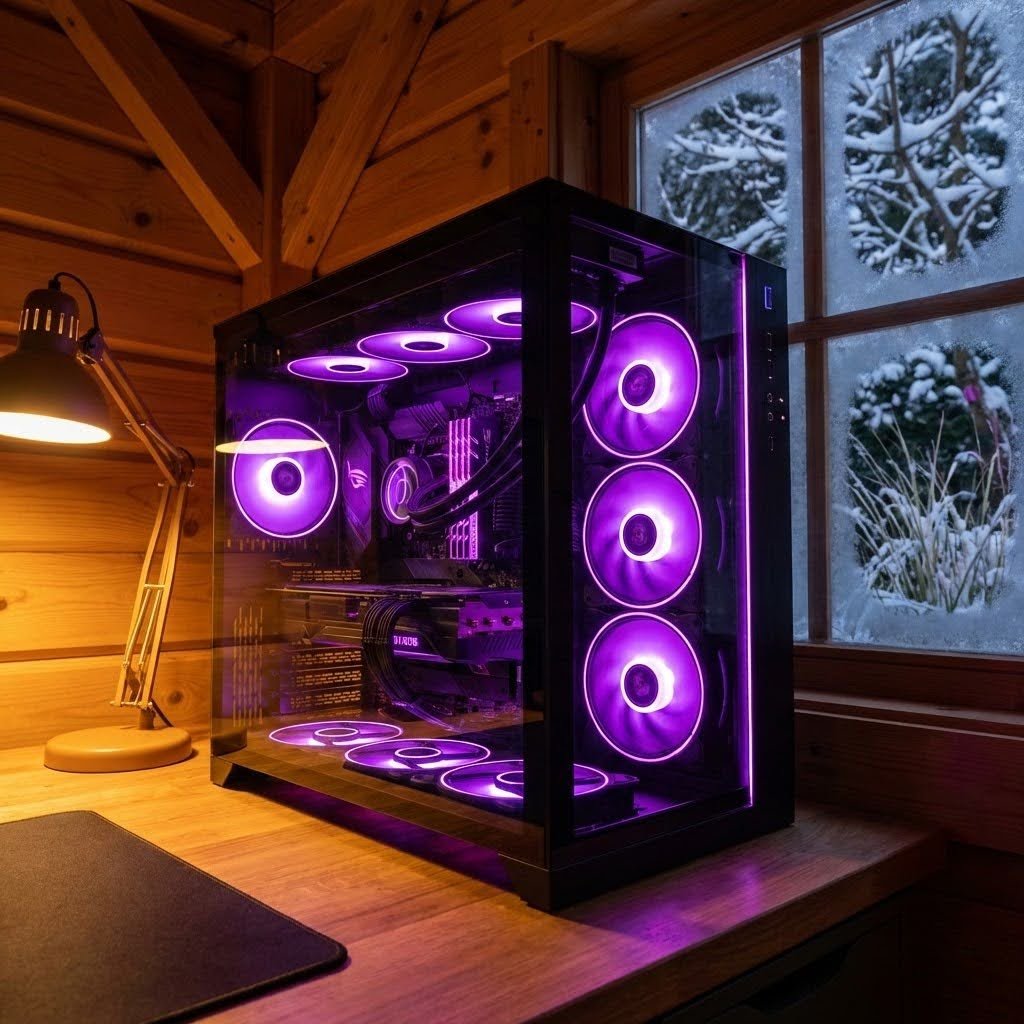
To quantify this heat issue, we conducted the “Thermal Choke” test in our own review setup. We installed a custom, top-tier workstation (featuring the RTX 5090 paired with an Intel Core i9-14900K) inside a standard 3x3m cedar-clad office pod. With the door closed and relying only on passive ventilation (i.e., a crack in the window), the ambient temperature shot up from a comfortable 18°C to an oppressive 28°C in under an hour.
This intense heat is more than just uncomfortable for the human occupant, potentially causing fatigue and loss of focus. Critically, it forces the hardware itself to react. Modern CPUs and GPUs are programmed with fail-safes. Once they reach a critical temperature threshold, they engage in “thermal throttling,” drastically cutting clock speeds and performance to prevent permanent damage. Essentially, the very environment you work in ends up killing the performance you just paid £1,800 or more to achieve. You pay for a Ferrari, but the heat forces it to drive like a bicycle.
Deep Dive: Comparison and the Hidden Costs
The table below outlines the key specifications and, more importantly, the impact of upgrading from the previous generation to Blackwell.
| Feature | RTX 4080 Super | RTX 5080 (Blackwell) | Garden Impact & Hidden Cost |
| CUDA Cores | 10,240 | 14,336 | Approximately 40% faster rendering and simulation speeds. Cost: Requires a better cooling solution to maintain peak performance. |
| VRAM | 16GB GDDR6X | 16GB GDDR7 | Faster local AI training and larger scene files. GDDR7 runs slightly hotter than GDDR6X. |
| Power Draw (TDP) | 320W | 400W+ | Significant heat gain in small, insulated spaces. This 80W difference is the margin between comfort and a thermal shutdown. |
| Fan Noise | 35 dB | 42 dB | Audible on high-gain microphones. Podcasters, streamers, or remote meeting participants may need noise-gating software or external water-cooling. |
The Essential Pre-Flight Checklist: Things to Consider Before Upgrading
The RTX 50-series is a spectacular piece of technology, but its purchase should be coupled with essential infrastructural upgrades to your garden office.
- Active Exhaust is Non-Negotiable: You simply cannot rely on passive, “breathable” timber or cracking a window. That only exchanges air slowly. You need a dedicated, powered system to move the sheer volume of hot air being produced. Invest in a high-quality, filtered intake and exhaust fan system—something like the AC Infinity Cloudline series is a popular choice. These systems actively pull stale, hot air out and draw cooler, filtered air in, maintaining a negative pressure that keeps the ambient temperature stable. Budget around £150–£250 for a quality, quiet system.
- Revisiting Power Circuitry: Many modern garden offices are wired with a dedicated radial circuit, often rated at 16A or 32A, running from the main house consumer unit. A 400W+ GPU, a 200W CPU, and supporting components (monitors, peripherals) can easily push the boundaries of a 16A circuit, especially if it’s shared with other high-draw appliances like a kettle, a space heater (in winter!), or a powerful laser printer. Action: Ensure your workstation is on its own dedicated circuit breaker, or at the very least, a heavy-duty 32A feed. Tripping the house breaker every time you hit “Render” is not a sustainable workflow.
- Acoustics and Noise: That jump from 35dB to 42dB might not sound huge, but decibels are logarithmic. A 42dB fan noise under load can easily be picked up by sensitive condenser microphones. Factor in the cost of an acoustic enclosure for your PC or, better yet, a custom water-cooling loop which can significantly reduce fan speeds and noise.
Conclusion: The Nvidia RTX 50-series is a must-buy for professionals serious about performance. The power is transformative. However, it’s a purchase that demands a corresponding investment in your workspace infrastructure. The simple truth is: you only get the performance you paid for if you invest in a £150 ventilation system first. Don’t let your thermal choke your triumph.