



Date: 5 February 2025
The Psychological Threshold: Combating Studio Stagnation
February in the UK climatic cycle represents a critical psychological juncture—the “Month of Endurance.” For the burgeoning cohort of garden office commuters, the initial, perhaps romantic, novelty of working amidst frost and crisp air has invariably dissolved. The anticipation of spring’s effervescence remains tantalizingly distant. This temporal and emotional vacuum often precipitates a recognized decline in motivation and focus, a phenomenon we formally define as “Studio Stagnation.” This state is characterized by decreased cognitive function, a diminished perception of the office space as inspiring, and a measurable dip in daily productivity.
To proactively counter this seasonal lethargy and re-establish the garden office as a sanctuary of sustained focus, we formally introduce the “Snowdrop Strategy.” This is a holistic, bio-centric design and protocol approach fundamentally centred on Eye-Level Planting to recalibrate the visual and emotional landscape of the workspace during the deepest part of winter.—–Micro-Dosing Nature: The Science of Eye-Level Biophilia
Traditional garden design prioritizes mass planting and ground-level displays. While aesthetically pleasing from a standing or walking perspective, this methodology fails to serve the seated commuter effectively. At a standard desk and chair height, the vital early signs of life—the emerging tips of bulbs—are frequently rendered invisible or, worse, are intentionally obscured by the lower sills and frames of modern insulated office windows.
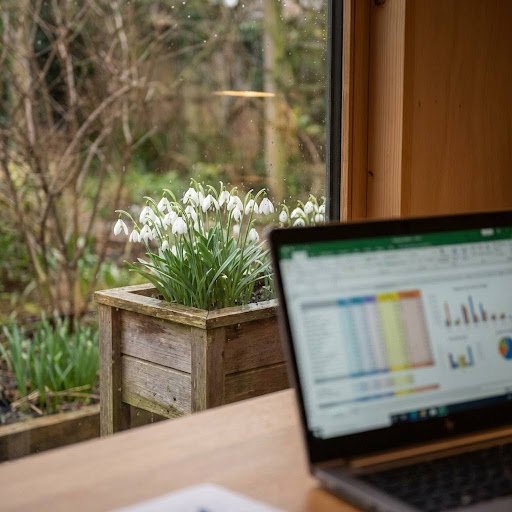
The Snowdrop Strategy mandates the strategic installation of high-quality, thermally insulated window boxes positioned precisely at the commuter’s typical seated eye level. This deliberate placement serves to bring the ‘first signs of life’—a powerful evolutionary trigger for optimism—directly into the occupant’s habitual, peripheral visual field. This constant, yet unobtrusive, exposure constitutes a “Micro-Dose of Nature,” leveraging the principles of biophilic design to enhance mood, reduce mental fatigue, and accelerate cognitive recovery. The window boxes transform the transparent boundary into a dynamic, living interface rather than a static frame.
The Prescribed Eye-Level Planting Guide for February:
- Galanthus nivalis (Snowdrops): The foundational element. Their pure white, pendulous blooms are the quintessential, resilient symbol of hope and the triumph of life over dormancy. Their appearance, often through snow, provides an irrefutable visual promise of the changing season.
- Iris reticulata ‘George’: To counteract the pervasive muted tones of the late-winter landscape, ‘George’ offers a necessary infusion of saturated colour. Its deep, regal violet blooms contrast sharply and vibrantly against the typical brown and grey earth, providing a much-needed focal point of visual energy.
- Erica carnea (Winter Heather): Essential for texture and longevity. This low-maintenance evergreen provides structural integrity throughout the season and delivers a soft, subtle pink-to-mauve hue that is particularly adept at reflecting and catching the low, diffused light of the winter sun, adding warmth to the exterior view.
The “Fake Commute” Protocol: Structuring the Work/Life Transition
A significant risk factor for burnout in remote work is the dissolution of the boundary between home and professional life, commonly resulting in the insidious “Always-At-Work” feeling. Without the physical transition inherent in a traditional commute, the brain struggles to switch context effectively. To mitigate this, we propose the 10-10-10 Rule for implementation specifically during the critical month of February: a structured, three-part protocol designed to bookend the workday with intentional, boundary-defining activity.
- 10 Minutes (The “Activation”): A brisk, intentional walk around the garden perimeter or the local block before physically entering the office structure. This acts as a kinetic, cognitive priming exercise, signaling the shift from ‘home’ to ‘work’ and elevating heart rate and mental alertness.
- 10 Minutes (The “Recalibration”): Dedicated time during the mid-day break (lunchtime) for harvesting, deadheading, watering, or simple observation of the eye-level window boxes. This is a mindful, low-effort interaction with the natural world that provides a vital, short-term cognitive break and satisfies the inherent human need for stewardship.
- 10 Minutes (The “Deactivation”): A purposeful “dark walk” at or near 5 PM. This is a non-negotiable end-of-day ritual. The shift in light and the physical act of moving away from the office space signals to the limbic system that the professional workday is conclusively over, thereby aiding in rapid mental unwinding and promoting better quality rest.
M