


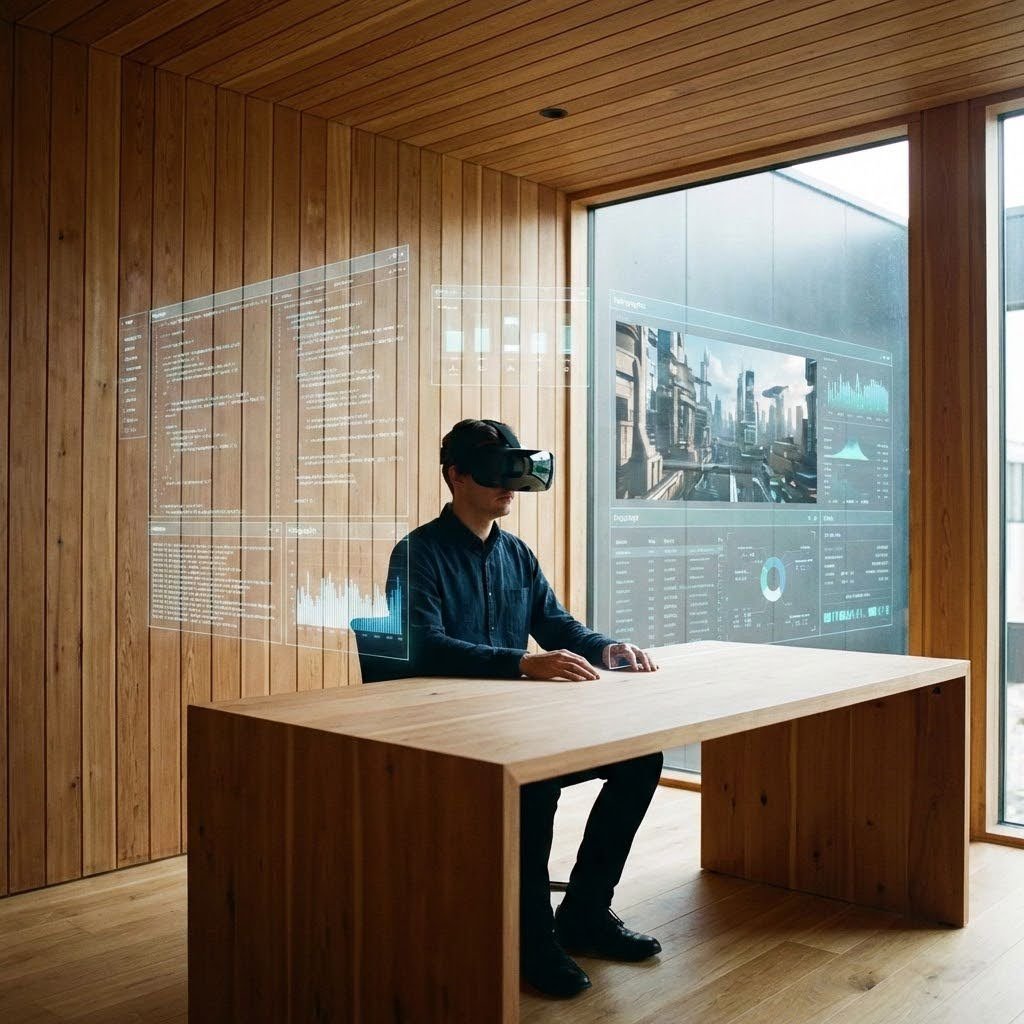
Can Vision Pro Finally Replace Your Triple-Monitor Setup?
Date: 18 April 2025
The Desk is Dead (Almost): Embracing the Spatial Office Revolution
It’s been a transformative journey since the Apple Vision Pro first landed on UK shores, but April 2025 marks a pivotal moment—it’s the month the technology genuinely “clicks” for the remote garden worker. The narrative is no longer about novelty; it’s about pure, practical productivity. The recent visionOS 26 update has fundamentally reshaped the landscape. Its introduction of “Spatial Personas” has moved the virtual meeting experience from a slightly uncanny, static headshot to a dynamic, seemingly human interaction. Participants now benefit from realistic head movements and micro-expressions, vastly improving non-verbal communication.
However, the chatter that’s truly electrifying the garden-shed forums and co-working Slack channels is the persistent rumour of the leaked M5 variant, anticipated to launch later this year. This chip upgrade is expected to address the critical power and thermal throttling issues that limit the current M4 generation, promising the sustained performance needed for a true 8-hour workday in the spatial realm.
In a typical 3x3m garden office pod, space isn’t just a convenience; it is your single most expensive and constrained commodity. Historically, the pursuit of productivity meant a bulky triple-monitor setup—an arrangement that devours desk depth, complicates cable management, and, crucially, acts as a significant heat generator, turning a small, sealed pod into a sauna during the summer months.
This month, our editorial team has been rigorously testing a “Desktop-Free” workflow. We paired the current Vision Pro with a Mac Mini M4, relocating the physical screens into the digital space. The result is nothing short of revolutionary: a virtual workspace that offers a 10-foot, ultra-wide canvas, instantly scalable to five or even seven virtual displays, all while demanding nothing more than a small, minimalist desk for the Mac Mini and a trackpad. Your physical pod’s limitations simply cease to apply.
The “Gaze Correction” and Enhanced Persona Advantage
One of the most compelling, if slightly subversive, anecdotal wins for the garden commuter is the concept of “Professionalism in PJs.” The psychological barrier of working from home is often the pressure to maintain a highly professional appearance for video calls. With the new “Enhanced Personas” feature—a highlight of the visionOS 26 release—this pressure is dramatically reduced.
The system’s AI renders a sophisticated, high-fidelity avatar of the user. This avatar can be configured to appear in professional business attire, regardless of the user’s actual clothing (be it a hoodie, pyjamas, or even gym gear). More importantly, the integrated Gaze Correction technology ensures that, no matter where your physical eyes are looking—glancing down at a physical notebook, checking a coffee mug, or being momentarily distracted by a squirrel running past the window—your virtual persona maintains perfect, unwavering eye contact with the client or colleague on the other end. It’s an invaluable tool for maintaining engagement and trust during high-stakes client calls, masking the casual reality of the remote work environment.
Hardware Comparison: Physical vs. Spatial Office
The table below breaks down the tangible cost, space, and environmental impact of the two leading setups for the modern garden office worker:
| Metric | Physical Triple-Monitor Desk | Apple Vision Pro (Spatial) | Impact Analysis |
| Physical Footprint | 160cm x 80cm desk (required for screens) | 100cm x 60cm desk (Minimalist Mac/Input) | Winner: Spatial. Reclaims up to 40% of the desk surface area. |
| Power Draw | ~150W (3 x 27” Monitors + Mid-Range PC) | ~40W (Mac Mini M4 + Headset charging) | Winner: Spatial. A 73% reduction in energy consumption. |
| Heat Output | High (Noticeable in small pods) | Low (Localized to device/Mac Mini) | Winner: Spatial. Dramatically reduces the need for constant air conditioning in a sealed pod. |
| Flexibility | Fixed to a single location and chair. | Work from the desk, the sofa, the patio, or any room. | Winner: Spatial. True mobility within the home/garden perimeter. |
| Entry Cost | £800 – £1,500 (Used/New Mid-range setup) | £3,499 (Headset Only) | Winner: Physical. High capital expenditure is the primary barrier to entry for the Spatial setup. |
Things to Consider: Reality Checks for the Virtual Commuter
While the Spatial Office promises a utopia of productivity, several practical hurdles remain, preventing a complete transition:
- The “Weight” Factor and Neck Fatigue: The biggest physical blocker remains the extended wearability. Despite persistent leaks about a new, more ergonomic “Dual Knit Band” and promises of lighter materials, wearing the headset for a full 8-hour shift still leads to noticeable “VR Face”—pressure marks around the eyes—and significant neck fatigue. For now, it is best framed as a 4-hour “Deep Work” tool, ideal for intensive coding, design sprints, or complex data analysis, but not yet a comfortable 9-to-5 replacement. Users typically rely on a hybrid approach, switching between the headset and a single physical screen.
- Connectivity and the Glitch Factor: The performance of Spatial Personas and the stability of virtual screen rendering are entirely dependent on a rock-solid Wi-Fi 7 backbone. Garden office locations, often situated at the edge of the property, commonly struggle with mesh network stability. If your garden mesh is flaky or suffers from signal dropout, your virtual avatar will “glitch,” freeze, or temporarily disconnect during the most important part of your pitch, shattering the illusion of professionalism. A dedicated fibre-optic connection or a high-powered point-to-point wireless bridge is now a mandatory prerequisite.
Conclusion: We aren’t quite at the “Shed-to-Ready-Player-One” stage where reality is entirely superseded by the virtual. However, for the garden-based consultant, developer, or designer who desperately needs a massive, multi-screen canvas in a physically tiny space, the Spatial Office powered by Vision Pro is no longer a futuristic concept. It is now a viable, tax-deductible reality that fundamentally redefines the relationship between physical space and digital productivity.