

Has the Right to Disconnect Actually Reached the Garden?
Date: 12 May 2025
The One-Year Check-In: From Legal Theory to Digital Ghosting
It has been roughly a year since the initial push for the “Right to Disconnect” legislation began to reshape UK employment contracts, moving the conversation from a theoretical HR guideline to a mandated operational reality. For the modern “garden commuter,” whose professional migration is measured in mere footsteps rather than miles, the traditional psychological barrier between work and home has all but dissolved. This spatial compression has made the “always-on” temptation a significant biological and mental trap. This month, our analysis shows a profound and necessary shift from passive compliance with legal theory to the active, technical enforcement we term “Digital Ghosting.”
The Corporate Shift: Recognizing Liability in Perpetual Availability
The initial attraction of the garden office—unfettered access and immediate responsiveness—has proven to be a double-edged sword for employers. Companies are beginning to realise that a garden-based employee who is perpetually connected and who never truly “leaves” the office environment is a significant liability, not a sustainable asset. The psychological cost of this boundary erosion is now measurable: burnout in the professional services sector relying heavily on remote and hybrid models rose by an alarming 8% in 2024.
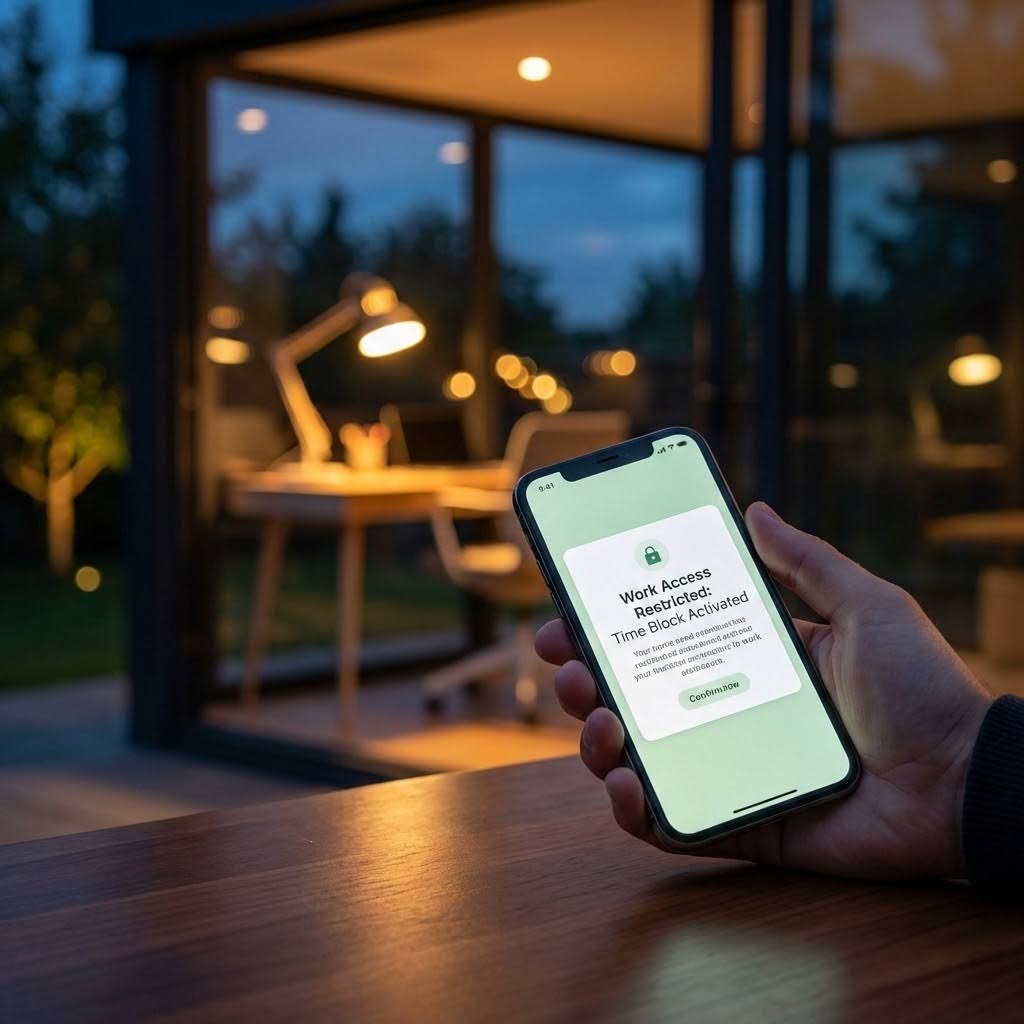
This alarming trend has not only prompted a cultural rethink but a new wave of legally sound, technical interventions: Hard-Boundary Contracts, which became prevalent in May 2025. These agreements move beyond merely “allowing” an employee the right to turn off; they actively and explicitly mandate disconnection. The most common and effective enforcement mechanism involves disabling server access for specific garden-based IP addresses or VPN connections after a designated cut-off time, typically 6:30 PM. This systemic removal of access is the core tenet of the Digital Ghost Protocol, ensuring that the work cannot physically follow the individual back into their personal life.
The “Boundary Anecdote”: A Case Study in Enforced Disconnection
The most compelling examples of this enforcement often come from the tech and creative sectors, where output hinges on cognitive freshness.
“I recently spoke to a Creative Director in Brighton, who oversees a highly dynamic but demanding team. He has implemented a system he calls the ‘Smart-Lock Lockdown.’ At precisely 6:00 PM, his bespoke garden office smart lock automatically engages, locking him out. Simultaneously, his dedicated Wi-Fi mesh network, provisioned specifically for the office pod, kills its signal entirely. He affectionately calls this routine his ‘Digital Airlock.’ Since implementing this non-negotiable hard stop, he reports a profound 30% increase in morning creativity and problem-solving ability, directly attributing it to the fact that his brain is actually forced to leave the building and fully enter a recovery state.”
This anecdote underscores a critical finding: true recovery requires involuntary separation. Self-discipline alone has proven insufficient to combat the Pavlovian response to a nearby device.
The Right to Disconnect: 2025 Status Report and Implementation Efficacy
The methods used to enforce the Right to Disconnect have matured from soft HR suggestions to robust IT policies. The table below details the most common strategies and their observed efficacy in the field as of May 2025:
| Feature | Implementation Method | Success Rate | Detailed Impact |
| Server Blackouts (Digital Ghosting) | Automated VPN shutdowns, IP blocking, or SSO (Single Sign-On) access revocation for garden office networks at a set time (e.g., 6:00 PM). | High | This is the most effective method, as it physically removes the possibility of work continuation, providing a non-negotiable hard stop. It shifts responsibility from the employee to the IT infrastructure. |
| Email Delayed Delivery | All outbound mail sent by managers or non-shift staff after 4:00 PM or on weekends is automatically held in a queue until 8:00 AM the next working day. | Medium | Effectively reduces the psychological pressure and ping anxiety of receiving non-urgent communications out of hours. However, it does not prevent the employee from writing emails late at night. |
| The “Garden Buffer” Protocol | Mandatory 15-minute “transition” period built into the end of the day, during which employees are required to step away from their desk before logging off their primary system. | Low | While designed to mimic a traditional commute and promote psychological ‘detachment,’ its success hinges entirely on self-discipline and is difficult for companies to effectively police or mandate. Often skipped during busy periods. |
| Contractual Fines/Penalties | Clearly defined financial or HR penalties for managers who routinely contact staff via non-emergency channels (email, non-critical texts) outside of specified working hours. | High | This is a crucial cultural lever. By penalizing the sender rather than the recipient, it drastically changes corporate behaviour and incentivizes managers to respect boundaries and plan communication proactively. |
Conclusion: The Digital Fence and the New Metric of Success
The garden office, in its purest form, should be a sanctuary—a place of focused productivity. However, this purity can only be maintained if a robust digital fence is built around it. The legislative push of the past year has culminated in a technological imperative: if a boundary is not enforced, it will be breached.
In 2025, the professional metric of success is undergoing a critical transformation. “Availability”—the perceived value of being perpetually online—is no longer the desired or sustainable metric. Instead, the focus has shifted entirely to “Output,” measured by quality, innovation, and long-term cognitive health. For the garden commuter, disconnection is no longer a luxury; it is the fundamental prerequisite for peak performance.
Last updated: 26 March 2026