


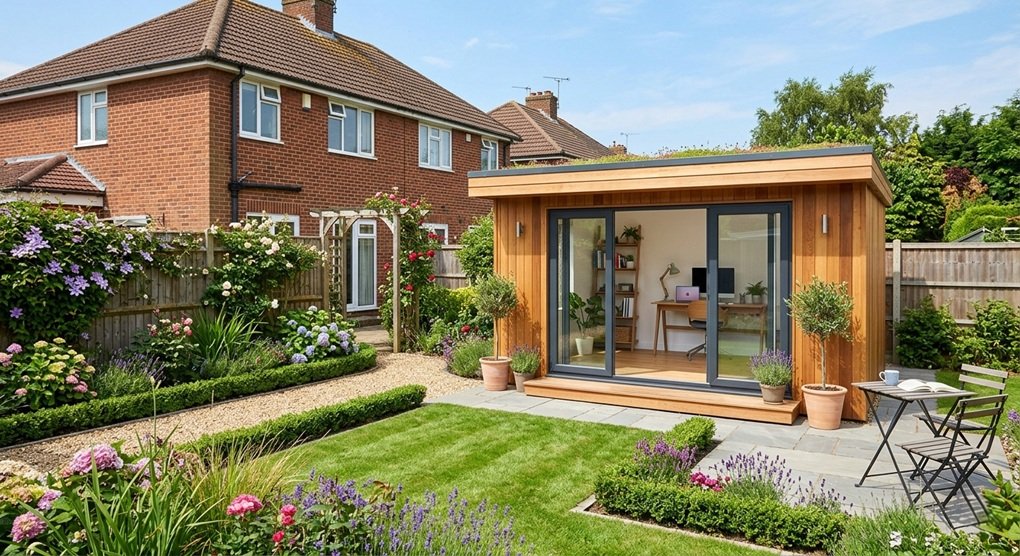
Foundations, Planning, and Prep Explained
Step 1: The Legal Check (Permitted Development vs. Planning)
Before you grab a spade, invite a single contractor over, or put down a deposit on a beautiful cedar studio, you need to clear the most important hurdle: the legalities.
In the UK, the vast majority of garden offices do not require a full, lengthy planning permission application. Instead, they can be built under Permitted Development (PD) rights. This is a massive win for your summer timeline, as it means you can theoretically bypass the local council’s backlog and start building immediately.
However, Permitted Development isn’t a free-for-all. It operates on a strict, non-negotiable set of criteria. If your build breaches even one of these rules by a single centimetre, you risk enforcement action down the line (which can mean an expensive, stressful retroactive planning application, or worse, being told to take it down).
Here are the critical boundaries you must navigate to ensure your summer project stays entirely legal:
1. The Height Restrictions (The 2-Metre Rule)
This is the trap that catches most homeowners off guard. Your maximum allowable height depends entirely on how close the building sits to your garden boundaries:
- Within 2 metres of a boundary: The absolute maximum height of the entire building—from the ground level to the highest point of the roof—cannot exceed 2.5 metres. This is why modern, flat-roofed “modular pods” are so popular in urban and town gardens; they are specifically engineered to sit just under this line.
- More than 2 metres from a boundary: If you have a larger plot and can place the office further away from your fences, your options open up. You can go up to 3 metres for a flat roof, or 4 metres for a dual-pitched (apex) roof.
2. The 50% Footprint Rule
Your garden office cannot swallow your entire outdoor space. Under PD, any outbuildings (which includes your new office, plus any existing sheds, greenhouses, or extensions built since 1948) cannot cover more than 50% of the total area of land around the original house. If you live in a town or suburban terrace with a compact garden, you’ll need to calculate this footprint carefully.
3. Incidental Use Only
To qualify under Permitted Development, the building’s use must be “incidental” to the enjoyment of the main dwelling house.
- What’s allowed: A home office, a creative craft studio, a micro-trade admin hub, a home gym, or a hobby space.
- What’s NOT allowed: You cannot install a bed and use it as regular guest accommodation, a self-contained holiday let, or a primary independent residence.
🛑 Important Exceptions to Keep in Mind
If your property is a flat or a maisonette, you do not have Permitted Development rights. Similarly, if your home is a Listed Building, or sits within a Conservation Area, an Area of Outstanding Natural Beauty (AONB), or a National Park, PD rights are often severely restricted or removed entirely. In these cases, you will almost certainly need full planning permission.
Take the Guesswork Out of Your Project
Because every property and garden is slightly different, it pays to double-check your specific setup before handing over any cash.
We’ve built a suite of free, interactive tools right here on the site to help you map out your project in seconds. Before moving on to your site layout and foundations, head over to The Garden Commuter Tools Hub, where you can use our:
- Permitted Development Checker: A quick, interactive questionnaire to see if your ideal office dimensions comply with UK rules.
- Budgeting & Planning Calculators: Estimate your spacing constraints and layout limits before the contractors arrive.
Up Next in This Series…
Once you know your project is legally sound, the next step is figuring out exactly where to put it—and choosing the right foundation to prevent damp and rot. In Step 2, we’ll dive into Site Selection & Ground Evaluation, followed by the ultimate showdown: Modern Ground Screws vs. Traditional Concrete Slabs.
Last updated: 10 June 2026