

Date: 20 June 2025
The “Sun-Sync” Economy: A Paradigm Shift in Remote Productivity
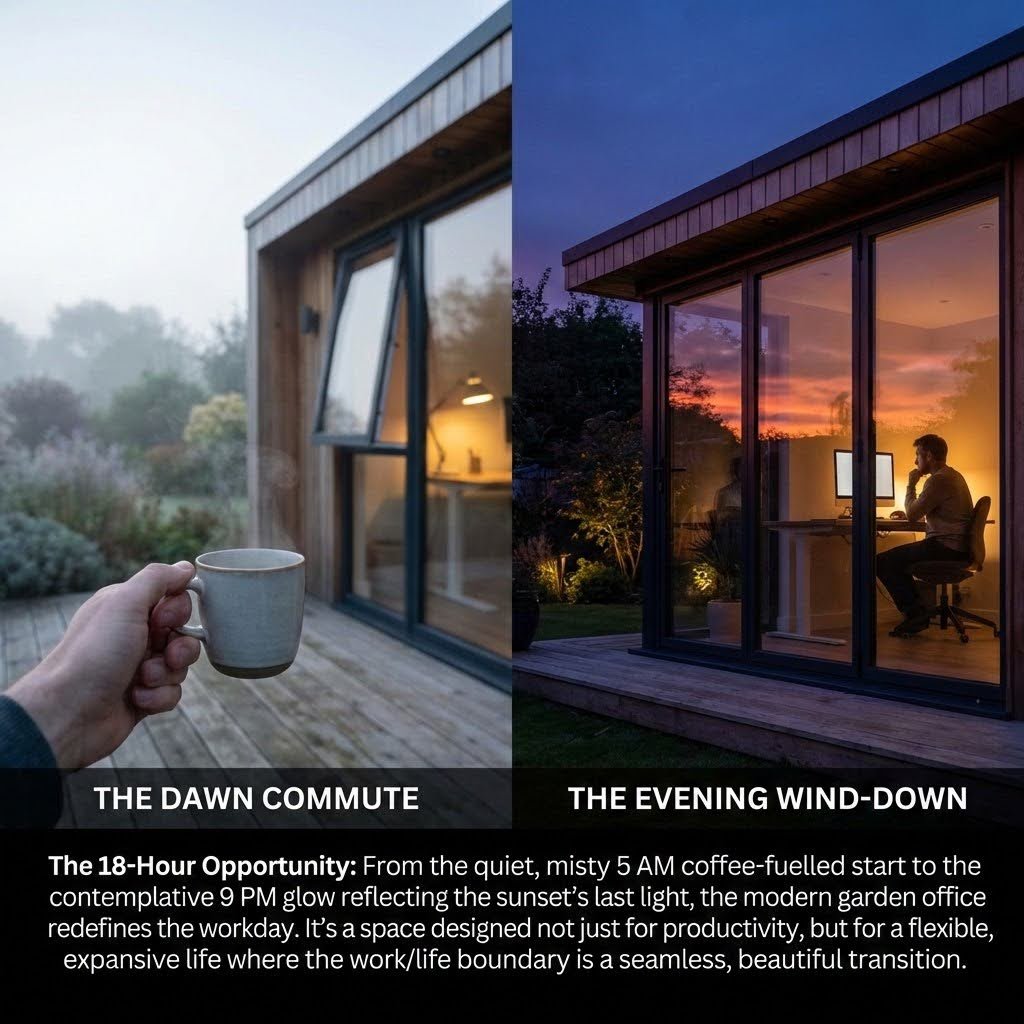
Today marks the Summer Solstice, the longest day of the year. For the estimated 4.9 million UK professionals who now commute to a garden office, this isn’t merely a celestial calendar event; it has become a powerful, quantifiable productivity catalyst. We are documenting a massive, sector-agnostic surge in what our analysis terms the “Solstice Sprint“—a radical, broken-shift working pattern where the 18 hours of available daylight are strategically leveraged to optimise cognitive performance and personal wellbeing. This trend represents a fundamental shift away from the rigid 9-to-5 structure, trading clock-watching for a rhythm dictated by natural light cycles.
The core principle of the Solstice Sprint is a hyper-flexible deployment of the working day, broken into focused blocks. Crucially, the 2025 Hybrid Work Census provides compelling data on this emerging standard. It reveals that a staggering 40% of garden-office-based workers are now adopting this flexible schedule. This typically involves initiating a “Deep Work” block as early as 5:00 AM, capitalising on the pre-dawn quiet for high-concentration tasks. This is then followed by an extended, non-working “Sun-Break”—often four hours long—during the midday period (10:00 AM to 2:00 PM) to garden, exercise, manage personal logistics, or simply rest. The working day culminates in a final “Collaboration” block, dedicated to meetings, communications, and administrative tasks, which runs into the cool twilight hours, often concluding around 7:00 PM or 8:00 PM. The physical and psychological separation provided by the insulated, dedicated garden office is the essential infrastructure enabling workers to fluidly enter and exit “work mode” multiple times a day without impinging on home life.
The “Midday Siesta” Anecdote: The Competitive Edge
“The most striking example I’ve encountered is a high-level Fintech consultant based in the Oxfordshire countryside who has completely abandoned the conventional midday grind. At exactly 12 PM, he rigorously locks his garden pod and spends three uninterrupted hours working on his small-scale meadow restoration project or cycling. He claims that his post-break, late-afternoon output consistently averages 50% higher than his peers. His belief is simple: he isn’t working a single hour more; he is strategically working better, more impactful hours, by leveraging a natural, restorative break. This radical yet simple application of chronobiology offers the ultimate competitive advantage for the empowered garden commuter over their city-bound, often fatigue-plagued, office-worker counterpart.”
Strategic Analysis: Pros & Cons of the Solstice Sprint Model
The Solstice Sprint, while innovative, is not without its trade-offs. Implementation requires a deliberate shift in both individual habit and organisational expectation.
| Metric | Strategic Pros (Advantages) | Operational Cons (Challenges) | Mitigation Strategies |
| Productivity | Access to high-focus, ‘Deep Work’ during the quiet dawn hours, aligning with natural circadian peaks. Enhanced creativity and problem-solving post-midday break. | Requires extreme personal discipline to transition and “log off” twice daily. Risk of ‘always-on’ creep. | Use of time-blocking software and a mandatory digital shutdown during the Sun-Break. Clear communication of unavailability. |
| Wellbeing | Massive reduction in Seasonal Affective Disorder (SAD) symptoms and chronic eye strain due to increased outdoor light exposure. Improved physical health from mandatory midday activity. | Potential for social isolation from peers who adhere to a traditional 9-5 schedule. Challenges in cross-timezone collaboration. | Scheduled, mandatory virtual or in-person “social sprints” with 9-5 colleagues. Utilise asynchronous communication tools. |
| Energy & Cost | Maximises the usage of locally generated power (e.g., solar-glass on the garden office roof), matching peak work with peak solar generation. Reduced strain on central office utilities. | High initial caffeine consumption is often necessary to fuel the 5:00 AM start. Potential for late-evening light pollution and heating costs. | Encouraging ‘micro-sleeps’ during the Sun-Break. Implementing smart-home automation for climate control and energy conservation in the pod. |
| Family & Social | Allows for unparalleled flexibility to attend mid-day school events, appointments, or significant personal projects like gardening. Increased capacity for personal errands. | Can significantly disrupt traditional “evening” family meal times and winding-down routines if the final block runs late. | Establishing firm ‘hard stop’ times for the final Collaboration block. Using the Sun-Break for high-value family time instead of the evening. |
Last updated: 26 March 2026