


Date: 10 July 2025
The Thermal Defense Strategy: From Aesthetic Greenery to Dynamic Climate Control
As the UK climate trajectory confirms that intense, sustained heatwaves are now a standard and predictable feature of the July calendar, the conventional function of the garden surrounding our commuter pods must undergo a fundamental re-evaluation. We must transcend the traditional view of greenery as mere decorative borders. In 2025, the garden is no longer a static backdrop; it is an integrated, dynamic Passive Cooling System. This strategic pivot necessitates a move away from purely ornamental planting schemes toward actively engineered “Evaporative Buffers.”
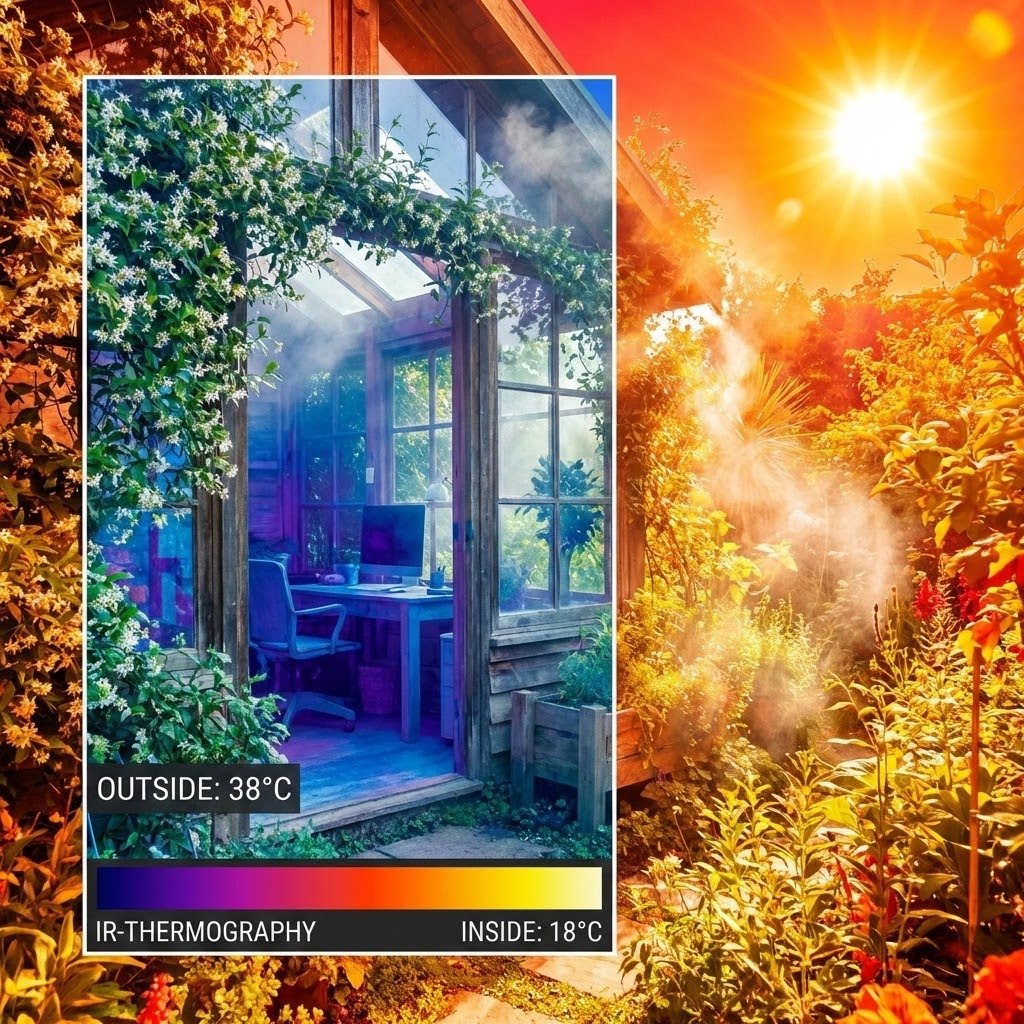
The thermal inefficiency of typical garden office construction—particularly units built between 2018 and 2022—has been acutely exposed. Standard timber cladding, a common aesthetic choice, can reach dangerous surface temperatures of over 50°C when exposed to direct July solar radiation. This superheated surface then becomes a substantial source of long-wave radiation, effectively creating a radiant “heat-bomb” that compromises the internal working environment. By deploying a scientifically informed “Vertical Mist-Scape” or similar evaporative architecture, it is possible to achieve a quantifiable reduction in the ambient temperature immediately surrounding the office structure by as much as 7°C—a significant thermal gain achieved entirely without the energy consumption associated with conventional air conditioning.
The “Mist-Scape” Implementation: Engineering the Cooling Envelope
This month, we strongly advocate for the sophisticated integration of a high-pressure, low-water-use misting system. Crucially, this system must be discretely hidden, ideally within the dense foliage of Trellis-Grown Jasmine. The high-pressure nozzles create an ultra-fine vapour that maximizes the surface area for evaporation. This process of phase change absorbs latent heat from the surrounding air. The objective is for the mist to fully evaporate before droplets can contact the ground or the building surface, thereby creating a pure “Cooling Envelope” of tempered air immediately adjacent to the office structure. This micro-climatic modification serves as the primary thermal barrier.
Advanced July Planting for Precise Thermal Regulation
Successful passive cooling relies on a multi-layered planting strategy that addresses ground heat, wall temperature, and solar canopy requirements simultaneously:
- Stachys byzantina (Lamb’s Ear) – The Reflective Ground Plane: This plant’s dense habit and unique morphological features—its silver, heavily “furry” leaves—are not merely ornamental. The dense trichomes increase the albedo (reflectivity) of the ground plane, effectively bouncing a significant proportion of incoming solar energy away from the soil. This prevents the soil from “baking” and becoming a secondary source of radiated heat that would otherwise contribute to a warmer ambient temperature around the lower vents and windows.
- Pleached Lime Trees (Tilia cordata) – The “Living Awning”: Traditional fabric awnings provide shade but often trap stagnant, superheated air against the building. Pleached Lime Trees, meticulously trained onto a two-dimensional frame, function as a superior “Living Awning.” Their critical advantage is bioregulation. The leaf canopy provides dense, high-level shade, intercepting direct solar gain, while the natural process of transpiration ensures continuous airflow and moisture release. This combination provides shade while actively cooling the intercepted air, a distinct thermodynamic advantage over inert materials.
- The ‘Moat’ Effect – Evaporative Micro-Rills: To address low-level heat ingress through the structure’s base, we propose the installation of small, shallow, discreet water rills running parallel to the base of the office windows. This “Moat” Effect is an ancient but highly effective thermal principle. As the surface water evaporates, it cools the immediately adjacent air column. This cooled, denser air is then preferentially drawn into the office through lower ventilation points and vents, providing a continuous supply of pre-cooled air.
The Wellbeing Conclusion: Productivity and Cognitive Safety in the New Climate
The imperative to actively manage the thermal environment of the garden office extends far beyond mere comfort or luxury; it is a critical matter of cognitive safety and sustained productivity. Extensive research confirms that elevated internal heat levels—exceeding optimal thresholds for sustained periods—significantly impair executive function, focus, and complex decision-making processes. By proactively designing and implementing a garden that functions as an intelligent, active climate moderator, the garden office user is not simply engaging in a leisurely pursuit of gardening. They are, in fact, operating as an environmental architect—a designer of their own climate-resilient workspace and, consequently, a guardian of their own professional efficacy.