


Date: 1 October 2025
The Winter Threshold: From Comfort to Critical Cost
As of today, the energy landscape for the UK’s burgeoning garden office sector has undergone a critical shift. The 10% rise in the Ofgem energy price cap is more than a statistical footnote; it is a seismic event for the estimated 2.5 million businesses and remote workers operating from standalone timber structures. For the ‘garden commuter,’ the practice of heating a dedicated outbuilding has crossed a critical “tipping point.” With the average annual dual-fuel bill now indexed at a formidable £1,717, the thermal efficiency of a garden office is no longer a peripheral issue of personal comfort—it is now a central determinant of business solvency and household budgeting. The additional cost burden over the core five-month winter period (November to March) mandates an immediate re-evaluation of building fabric and heating methodologies.
The ‘Energy Efficiency Rating’ (EER) for Remote Roles: A New Contractual Reality
October 2025 marks a foundational change in the structure of hybrid employment. We are observing the rapid introduction of “EER Clauses” into professional contracts, reflecting a growing awareness among employers of the hidden costs associated with remote work.
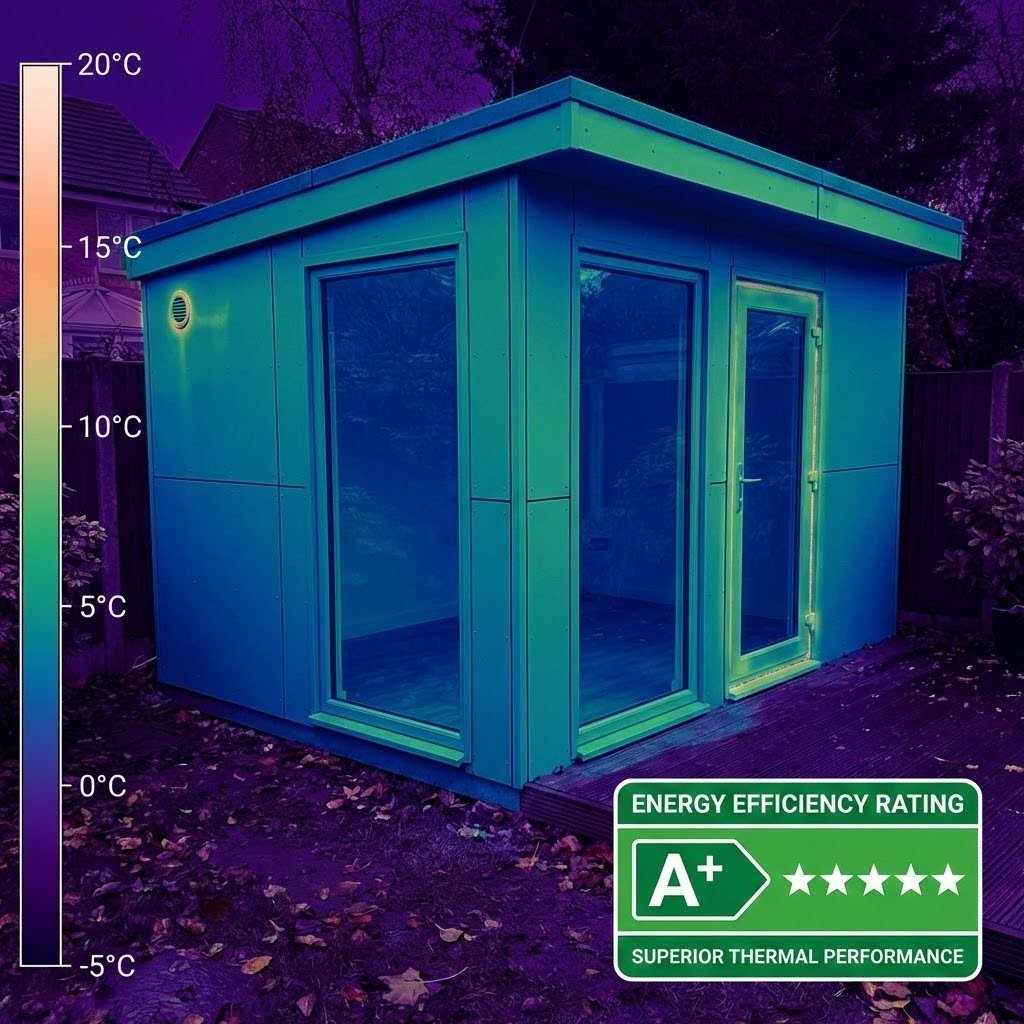
Forward-thinking firms, particularly those in the highly competitive finance and technology sectors clustered around the City and major regional hubs, are now offering “Energy Subsidies” or Work-From-Home Allowances with a crucial contingency: eligibility is tied directly to the thermal efficiency standard of the employee’s garden office. This phenomenon represents the first documented instance where the physical infrastructure of a private, standalone workspace directly and demonstrably impacts an employee’s effective take-home pay or net disposable income.
As detailed in recent field audits:
“I’ve spent the morning auditing the operational costs for a mid-sized consultancy based in the Oxfordshire tech corridor. Their analysis clearly demonstrates the ‘Efficiency Gap.’ They’ve calculated that a newly constructed, compliant garden pod featuring 100mm PIR insulation costs an estimated £1.20 a day to maintain a comfortable working temperature. In stark contrast, an older, non-compliant 44mm log cabin, often relying on inefficient electric convection heating, incurs a daily running cost approaching £4.00. Over a standard 140-day, five-month winter period, this disparity compounds to a substantial £420 ‘Efficiency Gap.’ This is capital that could have been allocated to essential business expenditure, such as a high-specification workstation upgrade, professional development courses, or an enhanced broadband package.”
The EER clause effectively transforms energy expenditure from a personal utility cost into a professional operational metric, placing a premium on insulation and thermal integrity.
October 2025 Financial Strategy: Prioritising Rapid-ROI Interventions
In light of the new price cap, a focus on low-cost, high-impact winterisation strategies is essential to rapidly recapture the 10% increase in utility costs. The following interventions are recommended for immediate implementation, based on their accelerated Return on Investment (ROI) period:
| Strategy | Implementation Cost (Est.) | Potential Savings (Winter ’25) | Mechanism of Saving | ROI Period |
| Zonal Infrared Heating | £150 – £300 | £120 (Equates to a 30% reduction in heating energy) | Direct radiant heating of objects and people, avoiding the inefficient heating of air volume common with convection heaters. Used only in occupied ‘zones.’ | 1.5 Winters |
| Thermal Blind Retrofit | £80 – £200 | £45 (Preventing significant night-time heat loss) | Installation of thick, thermally-lined roller or roman blinds over the single largest source of heat loss: glazing. Forms an insulating air barrier overnight. | 2 Winters |
| Draft-Excluder Audit (Sealing) | £15 | £20 (Eliminates critical ‘micro-leaks’) | Systematic inspection and sealing of gaps around windows, doors, cable entry points, and skirting boards. Prevents continuous influx of cold air. | 1 Month |
| Smart TRV Integration (Radiators) | £60 per radiator unit | £30 (Enables precision scheduling and temperature control) | Replacement of standard thermostatic radiator valves with smart, app-controlled units. Allows for room-by-room, time-based temperature control, preventing overheating during non-working hours. | 2 Winters |
| Long-Term: Cavity/Wall Insulation | £1,500 – £3,000 | £300+ (Reduces baseline heat demand) | Installation of high-performance insulation (e.g., PIR or Mineral Wool) within existing wall or roof cavities. Targets the fundamental thermal envelope weakness. | 5 – 8 Years |
The immediate focus for all garden office occupants must shift from reacting to the cold with increased heating to preventing the heat from escaping in the first place. The highest priority is any measure with an ROI of under two years, ensuring that the initial capital outlay is recouped well before the next potential price cap review.
Last updated: 26 March 2026