


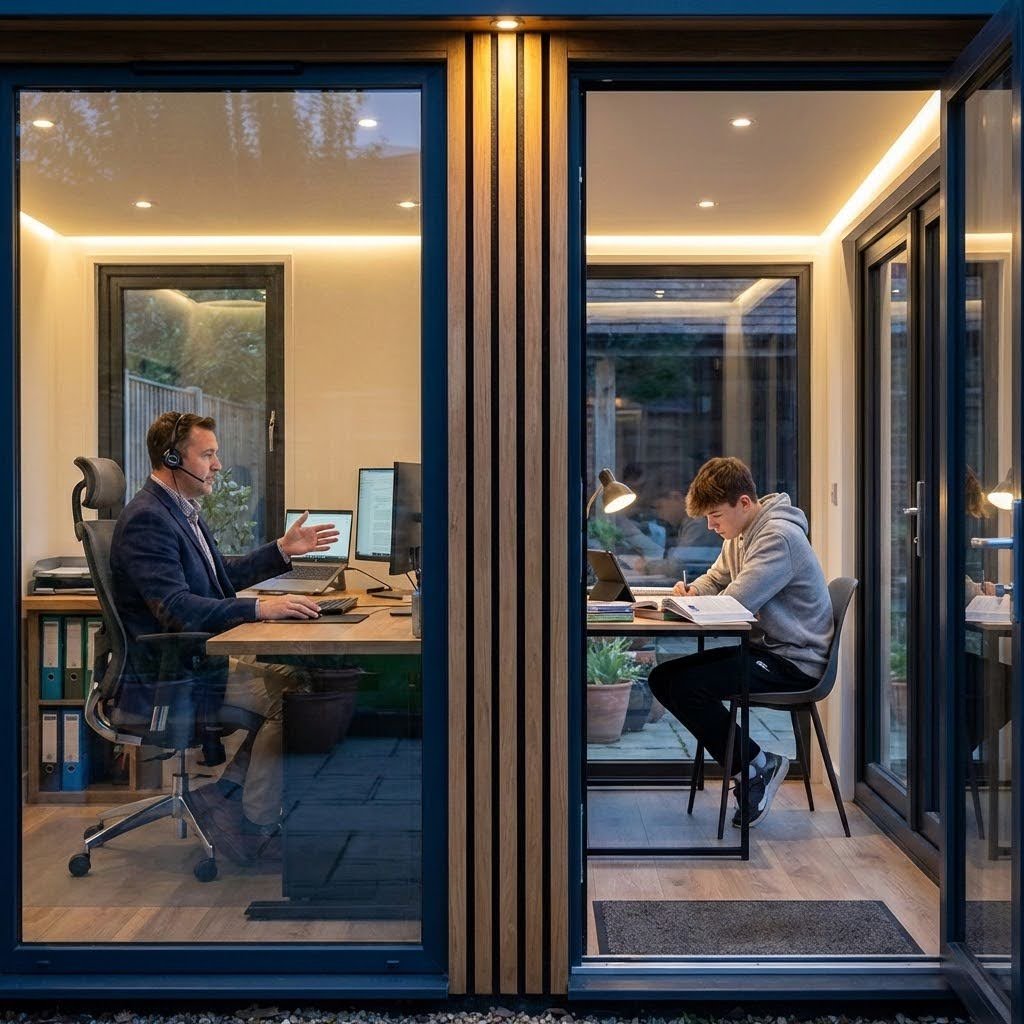
Navigating the Multi-Generational Shift in Garden Offices
Date: 2 September 2025
The September 1st Pivot: The Rise of the Scholarly Shed
Yesterday marked the traditional return to school across most of the UK, typically signalling a return to quiet concentration for the millions of remote and hybrid workers. However, for a rapidly growing segment of ‘garden commuters,’ the house didn’t get any quieter. We are witnessing a significant, post-2024 behavioural and infrastructural shift that we term the Education-Pod. The confluence of increasingly digitised GCSE and A-Level curricula, the rising cost of private tuition space, and the enduring need for adult “Deep Work” solitude has catalysed the re-imagination of the garden office as a shared, multi-generational sanctuary. This is no longer just a workspace; it is the family’s intellectual engine room where professional productivity meets focused academic study.
The Shared-Space Compromise: Acoustic Zoning and the Golden Hours
The era of the garden office being a parent-only domain is over. The “9-to-3” window remains the new golden hour for uninterrupted adult work, but from 4:00 PM onwards—and throughout school holiday periods—the garden office is increasingly morphing into a secondary, distraction-free classroom. This profound shift requires sophisticated space management.
This month, we’ve conducted in-depth interviews with dozens of “Shed-Proprietors” who are successfully implementing Acoustic Zoning principles. This strategy involves the deployment of flexible, yet robust, physical barriers. Heavy, sound-dampening velvet or polyester curtains mounted on ceiling tracks, or lightweight, modular, interlocking acoustic partitions are the most popular solutions. This allows parents to successfully share their typically 4m x 3m pods with their children, providing an environment conducive to concentration that the busy, multi-functional kitchen table or open-plan living space simply cannot offer.
The success stories underscore the necessity of this compromise. “We were drowning in the house,” says David, a software architect from St Albans. “My daughter needed absolute silence for her advanced coding project and remote university modules, and I had back-to-back client calls that demanded privacy. We invested in a heavy-duty partition and split the pod down the middle. It’s not just an office anymore; it’s the family’s ‘Intellectual Hub.’ Our individual productivity has effectively doubled because the boundary between ‘home’ and ‘work’ is now a shared family value, reinforced by a physical structure.”
Operationalising the Multi-Generational Office
The transition to a shared-space model is not without its challenges, primarily centred on scheduling and infrastructure investment. Successful implementation hinges on three pillars:
- Strict Timetabling: A non-negotiable schedule, often colour-coded and displayed prominently, dictates who uses the primary audio/visual equipment, who takes the window-side desk, and crucially, the designated ‘silent hours’ for each occupant.
- Duplicated Infrastructure: To mitigate friction, families are investing in a second set of essential peripherals: monitors, ergonomic chairs, and high-quality noise-cancelling headsets. This is viewed as a strategic investment to support simultaneous ‘Deep Work’ and ‘Deep Study.’
- Connectivity Prioritisation: The existing Wi-Fi connection, often a single repeater from the main house, is now insufficient. Many are upgrading to a dedicated, hard-wired CAT6 ethernet connection or a mesh network extender within the pod to ensure high-speed, low-latency access vital for remote examinations and video conferencing.
Strategic Analysis: Pros & Cons of the Education-Pod Model
The adoption of the Education-Pod represents a clear ROI maximisation strategy for the garden office structure, yet it introduces new operational complexities that must be managed proactively.
| Feature | Pros (Benefits & Opportunities) | Cons (Challenges & Risks) |
| Space Efficiency & ROI | Maximises the Return on Investment (ROI) of a typical £25k-£40k outbuilding, transforming it from a single-user workspace to a family asset. Offers flexibility for future use (e.g., guest suite, gym). | Requires rigorous, non-negotiable scheduling to avoid conflict, requiring clear delineation of ‘Parent Time’ and ‘Child Time.’ |
| Mentorship & Skill Transfer | Parents can organically model essential professional habits—time management, focused concentration, digital etiquette—to their children, enhancing their study skills. | Potential for severe “work-creep” and “study-creep” into the evening, blurring the essential home/life boundary for both adults and children. |
| Cost & Academic Advantage | Negates the need for expensive external tutoring centres or shared library space, providing a high-value, familiar learning environment. | Increased wear and tear on high-value technology and furniture due to doubled usage, necessitating higher capital reserves for equipment replacement. |
| Wellbeing & Focus | Provides a dedicated, distraction-free environment essential for complex cognitive tasks that the chaotic main house cannot support. | Requires constant monitoring to ensure both occupants are respecting the acoustic and spatial boundaries set by the zoning measures. |
Last updated: 26 March 2026