


Selecting Late-Summer Flora for Continued Seasonal Focus
Keeping the Garden Office View Alive Through the Season
One of the understated advantages of working from a garden office is the ability to maintain a visual connection with the outdoors throughout the day. While spring planting often receives the most attention, many garden workspaces begin to lose colour, structure, and interest by late summer. Borders soften, blooms fade, and the sharp visual lines that once framed the office view begin to dissolve.
For professionals who spend long hours focused at a desk, the garden beyond the glass becomes more than decoration. It acts as a restorative visual horizon — a backdrop that supports concentration, reduces visual fatigue, and subtly changes with the rhythm of the seasons.
Late-summer planting offers an opportunity to extend that experience well into autumn. By selecting structural flora that thrives from August through October, garden office owners can preserve clarity, texture, and movement in the landscape during the period when many gardens begin to retreat.
Designing the Late-Season Workspace View
A successful garden office outlook should balance three elements:
- Structure — clear shapes and planting forms that remain visually organised.
- Movement — grasses and flowering stems that respond naturally to wind and light.
- Colour restraint — deeper seasonal tones that feel calm rather than overwhelming during working hours.
The goal is not to create a densely packed cottage garden directly outside the office window, but rather a composed scene that provides gentle stimulation without distraction.
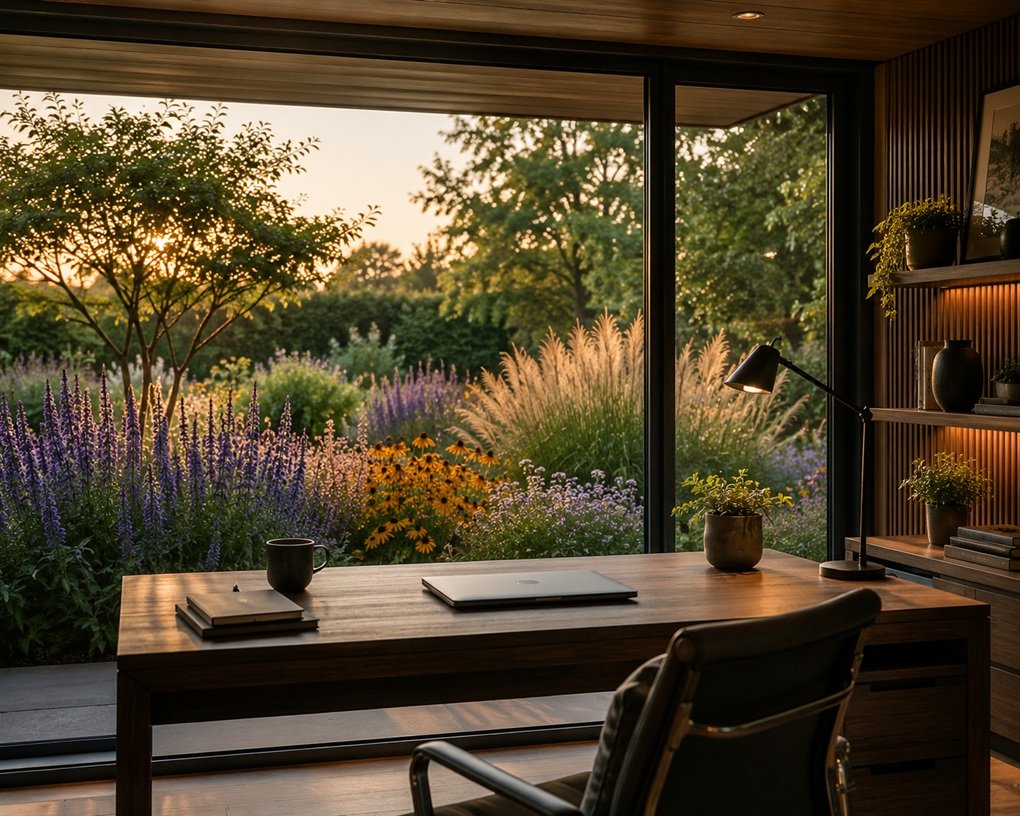
Late-summer planting works particularly well when viewed through large glazing panels or bifold doors common in modern garden office designs. Tall flowering perennials and ornamental grasses create natural framing, while repeated planting patterns provide visual rhythm from the desk.
Structural Plants That Carry the Season
Salvia ‘Amistad’
Few late-summer plants offer the same combination of elegance and longevity as salvia. Deep violet flowers held on dark stems create dramatic contrast against lighter foliage and contemporary office exteriors.
Placed near pathways or directly within sightlines from the desk, salvias continue flowering well into autumn while attracting bees and pollinators throughout the working day.
Their upright habit also prevents borders from appearing collapsed or untidy later in the season.
Rudbeckia fulgida ‘Goldsturm’
Rudbeckia introduces controlled warmth into the garden office landscape. Its golden-yellow flowers provide strong focal points without becoming visually chaotic.
When paired with dark timber cladding, black-framed glazing, or minimalist office architecture, the contrast can feel particularly refined.
Its long flowering period makes it ideal for maintaining visual energy during late afternoon working hours as daylight begins to soften.
Verbena bonariensis
For smaller garden plots, verbena offers height without heaviness. The airy stems allow light to pass through while still introducing movement and structure.
Positioned strategically near the office glazing, verbena creates layered depth without obstructing views across the garden.
Its loose, transparent form also pairs exceptionally well with ornamental grasses.
Japanese Anemones
Where a softer atmosphere is preferred, Japanese anemones bring calm late-season elegance.
White or blush-pink blooms work especially well in shaded garden office settings, reflecting available light back towards the workspace and brightening darker corners during overcast autumn mornings.
Their gentle movement in the breeze adds a sense of quiet activity to the garden without visual noise.
Miscanthus and Stipa Grasses
Ornamental grasses become increasingly important as summer transitions into autumn.
Rather than relying solely on flowers, grasses provide texture, silhouette, and movement — particularly effective when viewed during video calls or periods of extended desk work.
Morning light filtering through miscanthus plumes can completely transform the atmosphere of a garden office interior.
Colour Palettes That Support Focus
Highly saturated planting schemes can become visually tiring when viewed continuously throughout the workday.
Late-summer garden office planting benefits from a more restrained palette:
- Deep purples
- Burnished golds
- Soft whites
- Muted greens
- Bronze seed heads
These tones complement contemporary office materials such as cedar cladding, anthracite frames, concrete paving, and natural timber interiors.
The result feels sophisticated and restorative rather than overly ornamental.
Framing the Desk View
One of the most effective approaches is to treat the office window as a living landscape frame.
Rather than distributing plants evenly across the garden, consider concentrating late-season structure directly within primary sightlines:
- Position taller grasses slightly off-centre.
- Layer flowering perennials at mid-height.
- Maintain clean foreground edges near glazing.
- Use repetition rather than excessive variety.
This creates visual coherence from the desk while preserving a sense of calm order.
The most successful garden office landscapes often feel intentionally edited — closer to a curated courtyard than a traditional mixed border.
Extending the Garden Office Season
As daylight shortens, the relationship between workspace and garden becomes even more important.
Late-summer planting prolongs the usefulness of the outdoor environment by keeping the landscape visually alive during a period when many gardens lose momentum. Even on demanding workdays, a carefully designed horizon of movement, texture, and seasonal colour can subtly improve the quality of the working environment.
For garden office owners, planting decisions are not simply horticultural choices. They shape the atmosphere of the workspace itself.
A thoughtful late-season border ensures that inspiration continues long after the height of summer has passed.