


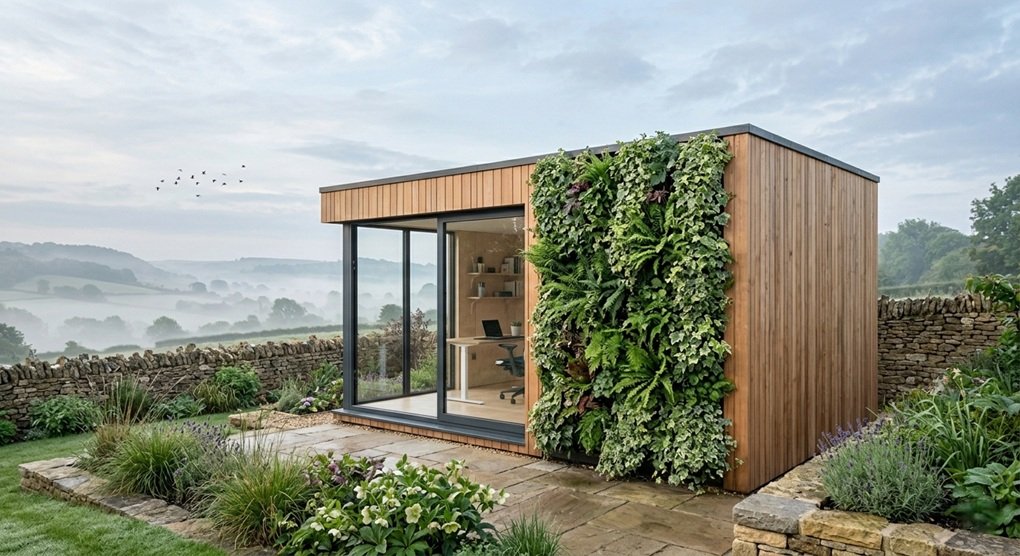
Integrating Structural Planting to Optimise Thermal Mass
As the late afternoon sun hits your garden office, a familiar challenge can arise for remote professionals operating from timber structures: mid-summer overheating. While modern garden studios are excellently engineered to retain heat during icy January mornings, that same tight insulation can trap ambient heat when temperatures climb. Relying entirely on energy-intensive air conditioning units drives up utility bills and runs counter to the eco-friendly, sustainable ethos of a true garden-based workspace.
The solution lies in biophilic architecture—specifically, using structural, living plant matter to naturally regulate your studio’s micro-climate. By strategically integrating climbing flora, living walls, and green roofing systems, you can harness natural thermal mass and shade to keep your working environment perfectly temperate, crisp, and focused.
The Science of Botanical Insulation: Shading and Evapotranspiration
Plants do not merely block sunlight; they actively manipulate the atmosphere around them. When applied to a detached timber office footprint, structural planting protects your workspace through two primary natural mechanisms.
- The Sol-Air Temperature Reduction: Direct sunlight hitting bare cedar or zinc cladding can raise surface temperatures well above ambient air levels. A dense layer of foliage acts as a natural shield, intercepting solar radiation before it ever reaches the physical fabric of your building.
- Evapotranspiration Cooled Air: Plants absorb water through their roots and release it as vapor through their leaves. This continuous cycle naturally absorbs ambient heat energy, creating a localized pocket of cool, conditioned air that wraps around the structural perimeter of your studio.
Architectural Green Frameworks: Living Walls vs. Green Roofs
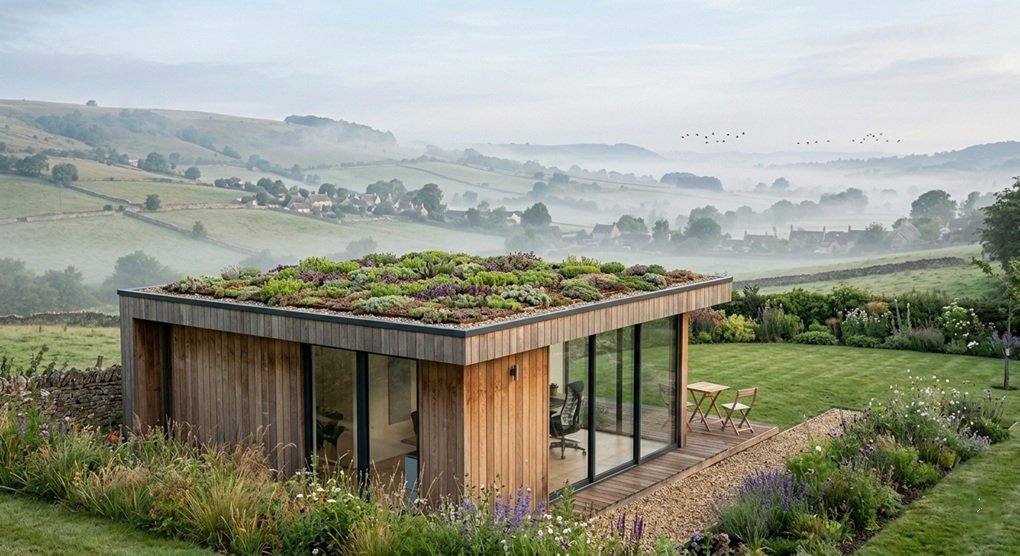
When choosing how to introduce structural planting to a premium garden studio, two main architectural systems offer distinct advantages for UK properties.
Modular Vertical Living Walls (Wall-Mounted)
These systems involve securing specialized irrigation matrices directly over your exterior cladding, allowing a dense blanket of evergreen and seasonal flora to grow vertically up the structure.
- Pros:
- Delivers a striking, high-end architectural aesthetic that beautifully blends a modern cedar pod into the surrounding garden landscape.
- Provides exceptional localized cooling on south- and west-facing walls, which typically bear the brunt of intense afternoon heat.
- Acts as an extra layer of structural acoustic isolation, dampening ambient neighborhood noise before it hits the studio walls.
- Cons:
- Requires a dedicated, automated drip-irrigation system to ensure the plants remain hydrated and healthy during dry spells.
- Demands periodic maintenance, including trimming and seasonal feeding, to keep the vertical matrix looking immaculate.
Extensive Sedum Green Roofs (Roof-Mounted)
This involves laying a lightweight, self-sustaining mat of hardy succulents directly over a reinforced, fully waterproofed flat roof membrane.
- Pros:
- Dramatically increases the roof’s thermal mass, preventing downward solar heat transfer through the ceiling of your office.
- Absorbs up to 70% of local rainfall, significantly reducing rainwater runoff and easing pressure on garden drainage systems.
- Requires virtually zero maintenance once established, as sedum varieties are naturally resilient against harsh wind, frost, and drought.
- Cons:
- The structural timber frame of the office must be engineered from the start to support the added weight of wet soil and plant mass.
- Retrofitting a green roof onto an existing, standard lightweight pod can be complex and may require structural reinforcement.
The Placement and Botanical Selection Strategy
To maximize the passive cooling efficiency of your biophilic setup without overloading your maintenance schedule, a targeted planting approach is ideal.
For a classic UK garden setup, focus your vertical greening efforts on the south-west elevations of your pod, as this is where solar heat gain peaks between 2:00 PM and 6:00 PM. Instead of aggressive, self-clinging vines like traditional ivy—which can root into timber joints and compromise cladding—opt for a sleek, stainless-steel cable trellis system.
Planting elegant, deciduous climbers like Wisteria or Clematis creates an ideal seasonal shield: their lush summer canopy blocks out the intense heat while you work, but they drop their leaves entirely in autumn, allowing the welcome winter sun to shine right through and naturally warm your workspace.