

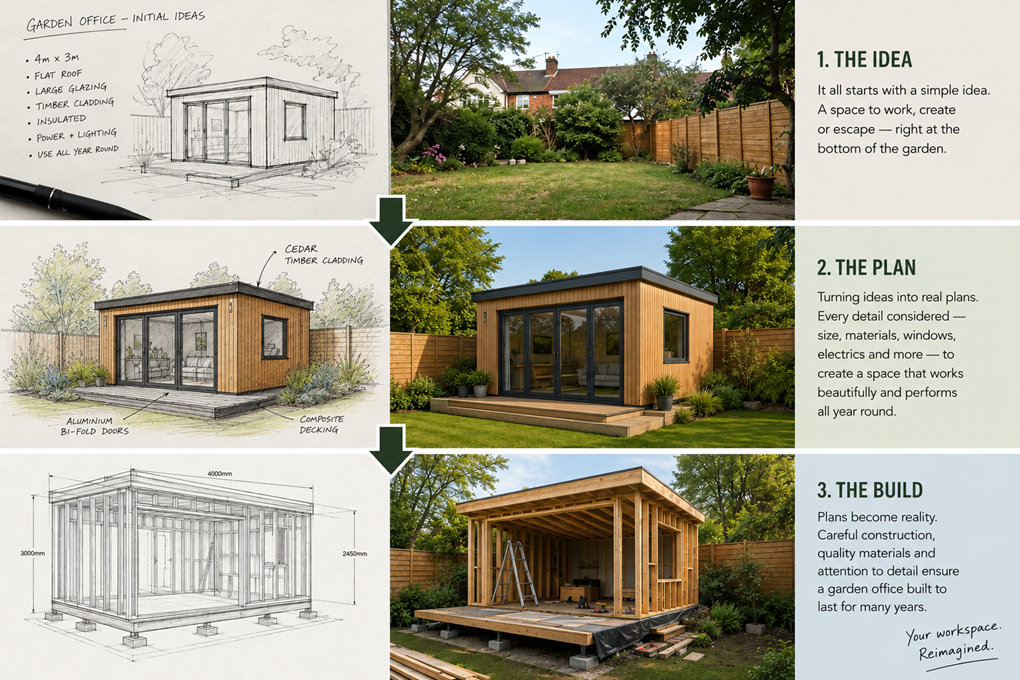
Everything You Need to Consider Before You Build.
Planning Your Garden Office: Getting the Foundations Right
The growth of remote and hybrid working has transformed the humble garden shed into something far more sophisticated. Today’s garden offices are insulated, connected workspaces that can add value to a property while dramatically improving work-life balance.
Before choosing cladding colours or window styles, it’s important to understand the key decisions that will influence the performance, lifespan, and cost of your garden office.
Start With Space and Size
One of the biggest mistakes homeowners make is building too small.
A garden office should accommodate not only your current needs but also future requirements. Consider:
- How many people will use the space?
- Will it be exclusively for work?
- Could it double as a gym, studio, guest room, or hobby space?
- Do you need room for storage?
- Will you regularly host meetings?
As a general guide:
| Usage | Recommended Size |
|---|---|
| Single workstation | 2.5m x 2.5m to 3m x 3m |
| Full-time office | 3m x 4m |
| Office plus meeting space | 4m x 5m |
| Multi-purpose garden room | 5m x 5m and above |
Remember to think about ceiling height as well as floor area. Higher ceilings create a more comfortable and professional working environment.
Choosing the Right Foundation
A garden office is only as good as the foundation beneath it.
Concrete Slab Foundation
A reinforced concrete slab provides a solid, permanent base.
Pros
- Extremely durable
- Excellent load-bearing capability
- Suitable for larger buildings
- Minimal movement over time
Cons
- Higher installation cost
- Longer build time
- Greater environmental impact
- Difficult to modify later
Best suited to larger garden offices and buildings intended for year-round use.
Ground Screw Foundations
Ground screws have become increasingly popular for modern garden room construction.
Pros
- Fast installation
- Minimal ground disturbance
- No excavation required
- Suitable for sloping sites
- Environmentally friendly
Cons
- Higher material cost
- Not suitable for every soil type
- Requires specialist installation
Ideal for premium garden offices where speed and sustainability are priorities.
Concrete Pads
Concrete pads support timber bearers at strategic points.
Pros
- Lower cost
- Less excavation
- Quicker installation
Cons
- Less suitable for very large structures
- Ground movement can affect stability over time
A popular solution for small to medium-sized garden offices.
Brick or Timber Construction?
Timber Frame Construction
Most modern garden offices use timber frame construction.
Pros
- Faster build times
- Excellent insulation performance
- Sustainable material
- Cost effective
- Easier to customise
Cons
- Requires quality weatherproofing
- Dependent on good construction standards
For most homeowners, a well-built timber frame is the preferred option.
Brick Construction
A traditional brick-built garden office offers permanence and familiarity.
Pros
- Exceptional durability
- Low maintenance
- Traditional appearance
- Strong thermal mass
Cons
- Higher cost
- Longer construction period
- More substantial foundations required
Brick construction makes sense where the garden office is intended as a permanent extension of the home.
Cladding Options
The exterior finish dramatically affects appearance and maintenance requirements.
Cedar Cladding
A premium choice that naturally weathers to a silver-grey finish.
Pros
- Beautiful appearance
- Naturally durable
- Low maintenance
Cons
- Higher initial cost
Thermowood Cladding
Heat-treated timber with improved stability.
Pros
- Sustainable
- Resistant to movement
- Attractive contemporary finish
Cons
- Requires occasional maintenance
Composite Cladding
Manufactured from recycled wood fibres and polymers.
Pros
- Minimal maintenance
- Long lifespan
- Modern appearance
Cons
- More expensive than some timber options
- Less natural aesthetic
Fibre Cement Boards
Increasingly used in contemporary designs.
Pros
- Extremely durable
- Fire resistant
- Low maintenance
Cons
- More industrial appearance
Roof Options
The roof design affects both aesthetics and internal space.
Flat Roof
The most common choice for modern garden offices.
Pros
- Contemporary appearance
- Cost effective
- Maximises internal headroom
Cons
- Requires high-quality waterproofing
Pent Roof
A single slope roof.
Pros
- Good water drainage
- Modern appearance
- Ideal for smaller gardens
Cons
- Reduced ceiling height at one end
Dual-Pitch Roof
Traditional pitched roof design.
Pros
- Familiar appearance
- Excellent drainage
- Additional roof space
Cons
- Higher construction costs
- Greater overall height
Insulation: The Difference Between a Shed and an Office
Insulation is arguably the most important component of a year-round garden office.
A fully insulated building should include:
- Floor insulation
- Wall insulation
- Roof insulation
- Airtight construction
- Vapour barriers where required
Common Insulation Types
PIR Rigid Boards
- Excellent thermal performance
- Thin profile
- Widely used in premium builds
Mineral Wool
- Good acoustic properties
- Fire resistant
- Lower cost
Wood Fibre Insulation
- Sustainable
- Breathable construction
- Excellent summer performance
For year-round comfort, insulation should never be treated as an optional upgrade.
Electrical Considerations
A garden office should be designed as a proper workspace rather than an extension lead from the house.
Consider:
Power Requirements
- Computer equipment
- Monitors
- Printers
- Heating
- Kitchen appliances
Connectivity
- Hard-wired ethernet connection
- Wi-Fi access points
- Future smart home integration
Lighting
- LED ceiling lighting
- Task lighting
- External security lighting
All electrical installations should be completed by a qualified electrician and comply with current regulations.
Doors and Windows: Double Glazing Is Worth It
Windows and doors significantly influence comfort, energy efficiency, and natural light.
Single Glazing
Pros
- Lower upfront cost
Cons
- Poor thermal performance
- Increased condensation
- Higher heating costs
Single glazing is rarely recommended for a garden office intended for year-round use.
Double Glazing
Pros
- Better insulation
- Reduced noise
- Improved security
- Lower energy consumption
Cons
- Higher purchase cost
For most garden offices, double glazing represents the best balance of performance and value.
Triple Glazing
Suitable where maximum thermal efficiency or noise reduction is required.
Door Options
French Doors
- Traditional appearance
- Wide opening
Sliding Doors
- Contemporary style
- Space efficient
Bifold Doors
- Maximum opening width
- Strong connection to the garden
For dedicated office use, a combination of large fixed glazing and a standard entrance door often provides the best thermal efficiency.
Final Thoughts
A successful garden office is more than a garden building. It is a workspace designed to be comfortable, energy efficient, and fit for daily use throughout the year.
While cladding colours and door styles attract the most attention, the long-term performance of your garden office depends on decisions that are less visible: foundations, insulation, structural materials, glazing, and electrical infrastructure.
Investing in these fundamentals from the outset will create a garden office that remains comfortable, functional, and valuable for many years to come.
Last updated: 10 June 2026