


Step 3: Battle of the Foundations (Concrete vs. Screws)
Welcome to the ultimate heavyweight matchup of the garden office world. Steps 1 and 2 ensured your build was legal and that your site was mapped. Now, you must make the single most consequential decision of the entire project: What will your office stand on?
For a four-season, high-specification garden office in the UK, the days of sitting a building on a few loose paving slabs are over. You are building a substantial structure; it requires a robust engineered foundation to prevent subsidence, damp, and structural twisting.
Today, the market is split between two dominant, modern methods. We are putting the traditional heavyweight, the Concrete Slab, into the ring against the modern challenger, Ground Screws.
Here is how they compare on the factors that matter most during a summer build.
The Head-to-Head Comparison
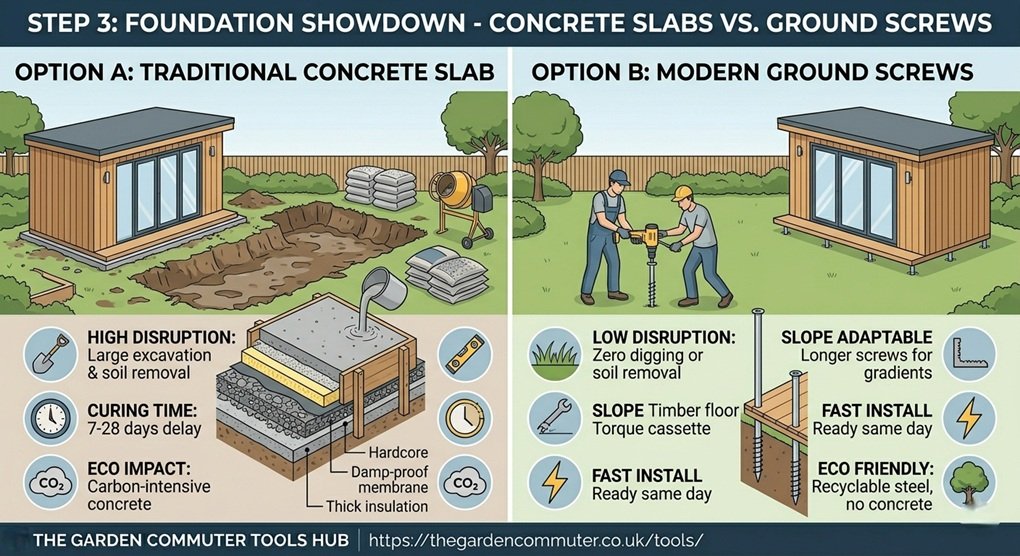
| Feature | Option A: Traditional Concrete Slab | Option B: Modern Ground Screws |
| Garden Disruption | High. Requires significant excavation (digging out your lawn), soil removal (muck-away), and heavy aggregate delivery. Your garden will be a building site for weeks. | Very Low. Small, handheld machinery installs the screws directly. There is zero digging, no soil to remove, and your lawn remains virtually untouched. |
| Sloping Ground | Difficult & Costly. A level slab requires either massive soil retention on the high side or expensive retaining walls on the low side to build the ground up. | Easy. The logic is simple: you just install longer screws on the downhill slope. Adjustable brackets easily compensate for variations in ground height. |
| Installation Speed | Slow (Weeks). Digging takes days. Pouring the concrete takes a day. The critical “curing” time (drying) can take 7 to 28 days before the office kit can be assembled. | Fast (Hours). A standard foundation can be fully installed, laser-leveled, and ready to support the timber base cassette in one working day. |
| UK Weather Factor | Vulnerable. Summer rain can delay the pour. Frost or intense, cracking heat can compromise the curing process, delaying your entire timeline. | All-Weather. Can be installed in the rain, frost, or heatwaves without issue. The ground conditions do not affect the installation timeline. |
| Eco-Credentials | Poor. Cement production is carbon-intensive, and a concrete slab permanently destroys soil biology underneath it. Very difficult to remove later. | Good. Made of steel (recyclable), uses no wet concrete, and causes minimal ground disturbance. If the office is removed, the screws can be wound out, leaving the garden intact. |
Which One Should You Choose?
The “right” foundation depends entirely on your specific site conditions and project priorities:
Choose Ground Screws If:
- You are building this summer and cannot afford a single week of delay.
- You have a sloping garden and want to avoid massive groundworks costs.
- Your site access is narrow (e.g., through a regular side gate).
- Your priority is protecting your lawn and existing planting.
Choose a Concrete Slab If:
- You have easy access (e.g., a wide driveway leading straight to the garden).
- Your garden is verified as perfectly level.
- You are planning a specialized build that requires significant weight-bearing (like a full-scale gym or a heavy industrial craft workshop).
Make an Informed Foundation Decision
Don’t let your supplier choose your foundation based on what’s easiest for them. The best foundation is the one that protects your specific investment and your garden.
Before booking a contractor, use our planning resources in The Garden Commuter Tools Hub to check your soil type and garden boundaries, ensuring your foundation layout doesn’t conflict with Step 2 (Tree Root Protection Zones!).
Up Next in This Series…
The legal checks are done, the site is selected, and the foundations are chosen. Now, it’s time to build. In Step 4, we lay out the definitive logical sequence to move your project from bare ground to a weather-tight, operational workspace.
Last updated: 20 June 2026