


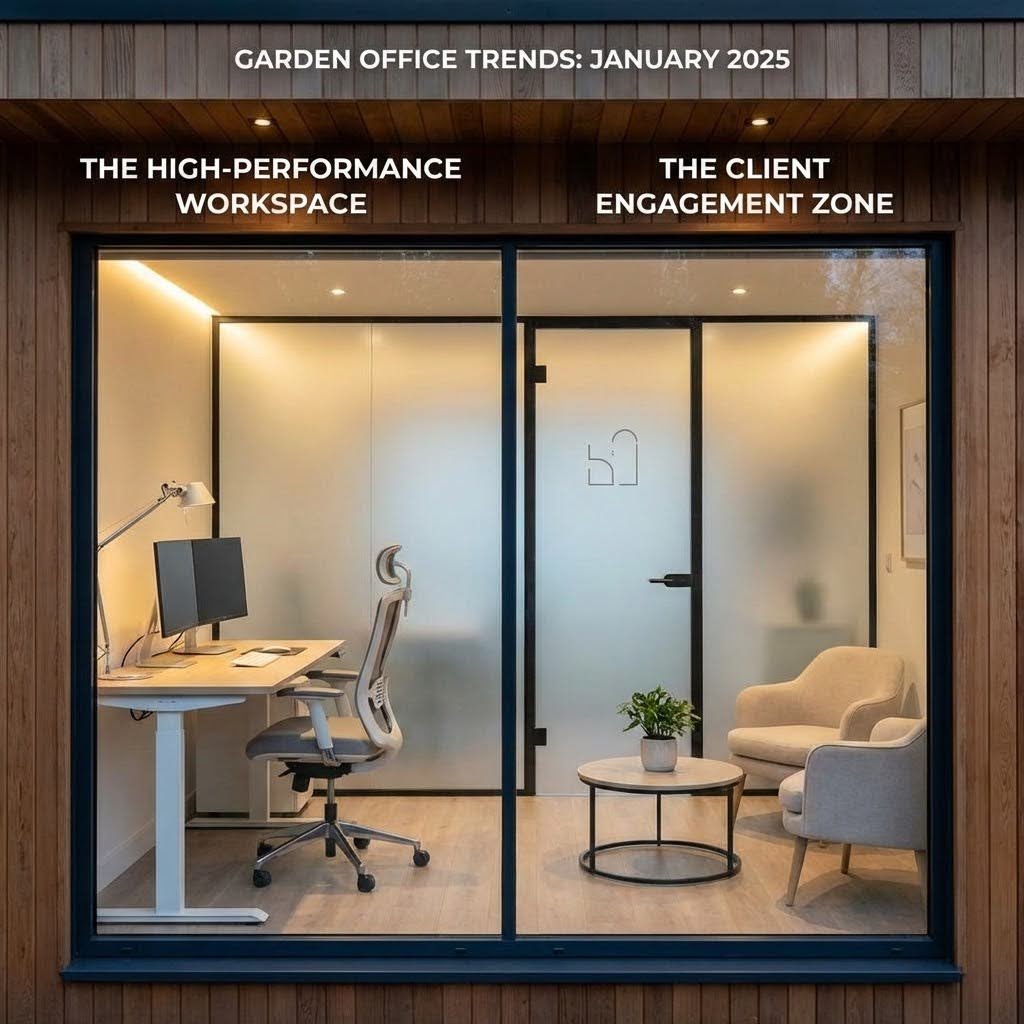
The Post-Election Shift: Professionalising the Garden Office
Following the transformative 2024 general election and the subsequent government-driven Planning Reform updates, the definition of the “Shed-Proprietor” is undergoing a critical evolution. We are witnessing a clear paradigm shift, moving decisively away from the concept of a simple, informal home office toward the highly professionalised Micro-Business Hub.
Under the current Labour government’s explicit “Growth” mandate, there is a distinct, policy-backed imperative to formalise and professionalise the vast home-working and micro-business sector. For a growing number of sole directors and founders, this mandate translates into a strategic necessity: registering their purpose-built garden outbuilding as a separate, designated business premises under the newly consolidated Use Class E. This reclassification is not merely administrative; it fundamentally changes the legal and fiscal status of the structure, unlocking significant commercial advantages.
Why Strategic Registration Under Class E is Essential
In the early months of 2025, the primary and most immediate driver for this formal registration is achieving comprehensive fiscal clarity and maximising legitimate expense claims. With the 31st January self-assessment tax deadline acting as a sharp reminder, the persistent complexity of “apportioning” household running costs (such as broadband, utilities, and mortgage interest) has reached a critical administrative breaking point for many small business owners.
By strategically designating the garden office as a distinct business asset—a separate, non-domestic entity—directors can dramatically simplify their tax position. This includes:
- Simplified VAT Reclamation: The entire VAT cost on the initial build, including materials, labour, and fit-out, can be reclaimed with minimal complication, provided the business is VAT registered.
- Aggressive Capital Allowances: Registering the structure allows for the immediate use of 100% first-year allowances, providing a powerful mechanism for accelerated tax relief on the significant upfront investment.
- 100% Running Cost Write-Off: Ongoing utilities, maintenance, insurance, and security costs associated with the structure become 100% allowable business expenses, eliminating the need for complex residential apportionment calculations.
“I recently consulted for a high-growth FinTech startup in Bristol where the founder moved from an expensive, serviced hot-desk in the city centre to a purpose-built 6x4m ‘Executive Pod’ in her garden. By formally registering it as her primary business address under Use Class E, she was able to achieve a total tax saving of £4,200 in her first year alone, primarily through the strategic application of capital allowances and VAT simplification.” — Helena, Workplace Strategy Consultant
The Business Rates Question: Navigating 2025 Guidance
The potential application of Business Rates is often cited as a concern for those considering the shift to Class E. However, current guidance offers significant protections for most micro-businesses, largely negating this risk. The Valuation Office Agency (VOA) assesses each case based on the building’s primary use and its degree of separation from the domestic dwelling.
| Scenario | Business Rates Status | Fiscal Impact & Context | Strategic Note |
| Sole Use (Professional) | Likely Exempt | Small Business Rates Relief (SBRR) is almost always applicable. If the Rateable Value (RV) is less than the current threshold (typically £12,000), the business pays 0% rates. | Optimal scenario for maximum fiscal benefits without rates liability. |
| Hybrid Use (Gym/Guest/Office) | Residential Council Tax | This mixed use fundamentally compromises the business-only designation. It makes the structure ineligible for SBRR and significantly complicates the ability to claim back 100% of VAT, capital allowances, and running utilities. | Avoid hybrid use if fiscal optimisation is the priority. |
| Client Facing (Studio/Salon/Clinic) | Rates May Apply | The VOA is mandated to reassess premises that exhibit a significant degree of commercial activity, particularly if there is a high volume of client or public footfall—a key indicator of an external business operation. | High footfall operations must budget for potential rates liability, though SBRR may still mitigate the cost. |
In summary, for the vast majority of professional directors and consultants operating a dedicated garden office, the financial benefits of strategic Class E registration—driven by aggressive tax allowances and administrative simplification—far outweigh the minimal risk of incurring Business Rates liability under the current SBRR provisions.
Last updated: 15 April 2026