


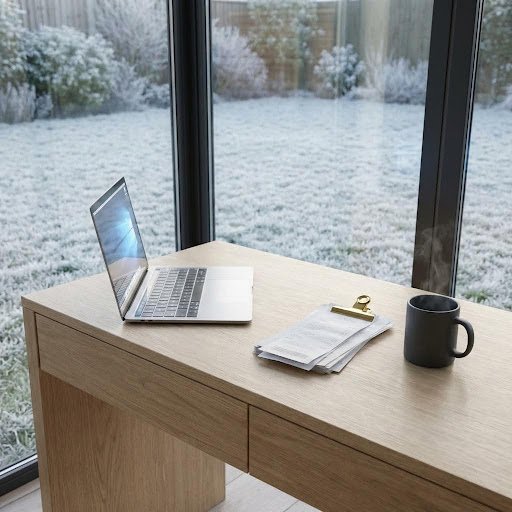
The January 31st Squeeze: Why Every Garden Commuter Needs a ‘Receipt Sanctuary’
Date: 15 January 2024
As the deep frost of mid-January settles on the garden office roof, a more chilling reality is setting in for the UK’s self-employed community: the fast-approaching January 31st Self-Assessment deadline. For the dedicated ‘garden commuter’—the professional operating from a sophisticated outbuilding—this annual task is not merely about collating invoices and tallying gross income; it’s a complex, high-stakes dance with HM Revenue & Customs (HMRC) over the fundamental definition of a “legitimate business environment.”
The concept of a “Receipt Sanctuary” is no longer an optional best practice; it is a critical, dedicated digital or physical filing system that must be meticulously maintained for your garden outbuilding. The necessity stems from HMRC’s stringent “wholly and exclusively” rule. This is the legal threshold you must meet to claim an expense: it must be incurred solely for the purpose of trade. For the garden office, this is where the line between a luxurious home-extension hobby room and a strategic, tax-deductible business asset becomes perilously thin.
Consider the common trap: if your highly specified garden office serves a dual purpose—say, a productive Monday morning meeting space and a Sunday morning yoga studio—you immediately compromise its “wholly and exclusively” status. This dual use requires not only complex apportionment but can, if inadequately documented, lead to a complete denial of tax relief and potential penalties. A bulletproof Receipt Sanctuary provides the irrefutable evidence—dated invoices, utility bills, and usage logs—required to withstand the intense scrutiny of an HMRC enquiry.The Capital Gains Tax (CGT) Trap: A Deferred Liability
One of the most significant and most overlooked financial pitfalls for garden office owners in early 2024 is the implication for Capital Gains Tax (CGT). Most residential homeowners benefit from Private Residence Relief (PRR), which exempts them from CGT on the sale of their main home. However, by claiming 100% business use for your garden office to maximise annual tax relief, you are effectively declaring that portion of your property as a non-residential asset.
When you eventually sell your main residence, you may find yourself unexpectedly liable for CGT on the proportional gain attributable to the office structure. For example, if your office represents 10% of your total property area and you claimed 100% business use, 10% of your total profit from the house sale could be subject to CGT at the prevailing rate. Mitigation strategies, such as meticulously calculating and documenting partial business use (less than 100%), are essential to protect the full benefit of PRR. This strategic calculation must be integrated into your annual tax planning, not merely considered at the point of sale.
Pros & Cons of Claiming Garden Office Expenses: A Detailed Breakdown
| Feature | Pros | Cons | Key Consideration |
| Business Rates | Typically exempt under ‘incidental use’ if the office is non-structural, small, and its use is secondary to the main dwelling. | Liability is triggered if you employ staff who work there, have regular client meetings, or if the office is fully independent of the house (e.g., its own services meter). | The local council, not HMRC, determines business rates liability. Always check the specific definition of ‘incidental use’ in your area. |
| VAT Reclamation on Build Cost | For VAT-registered businesses, a significant 20% saving can be reclaimed on the initial construction cost, materials, and labour. | Requires meticulous “apportionment” based on documented business use percentage. Any dual or personal use must be rigorously excluded from the claim. | Reclaiming VAT increases HMRC’s interest in reviewing CGT implications, as it solidifies the structure’s business asset status. |
| Running Costs | High-value, recurring deductions for electricity, gas, and broadband significantly reduce annual tax liability. | Proving the exact usage percentages to HMRC—often necessitating the installation of a separate electricity sub-meter or complex area-based calculations—is an administrative burden that requires year-round diligence. | The £6/week simplified flat rate is often easier for sole traders but usually results in a lower overall deduction than the true cost. |
| Repairs & Maintenance | Costs for essential upkeep like exterior painting, roof maintenance, and structural repairs are tax-deductible. | Only the business-use portion of the repair is deductible. Interior repairs specifically related to the business function (e.g., replacing office carpet) are more straightforward to claim. | Claims must align with the capital cost treatment. Large-scale improvements may be treated as capital expenditure, not running costs. |
Allowable Expenses Checklist (2023/24 Tax Year): A Practitioner’s Guide
- Broadband & Phone: Claimable only as a percentage based on documented business versus personal use. A separate business line simplifies this calculation significantly.
- Heating & Power: Calculated either by floor area (e.g., office square footage / total home square footage) applied to the total energy bill, or via the simplified flat-rate method (£6 per week for 2023/24) if working over 25 hours per week from home.
- Office Furniture & Equipment: Items such as desks, chairs, computers, and specialized machinery are 100% deductible as Annual Investment Allowance (AIA) or ‘Plant and Machinery’ in the year of purchase, provided they are used solely for business.
- Insurance: The business-specific element of contents and structure insurance, separate from the main home policy, is a valid deduction.
- Minor Repairs: Costs for quick fixes or regular maintenance directly impacting the business function (e.g., fixing a broken light fitting).
This article is a guide and where possible always consult a Financial Advisor for Accounting and Tax purposes, review HMRC guides within the HMRC Portal.
Last updated: 26 March 2026