


Are Garden Offices the Future?
January 2018
Categories: News & Trends
Tags: remote work, flexible working, early adopters
For decades, work has been something you travelled to. An office, a desk, a commute that quietly bookended each day. But cracks are beginning to show.
In recent years, flexible working has moved from a fringe perk to a serious conversation in boardrooms, HR departments, and kitchen-table negotiations across the UK. Cloud-based tools, faster home broadband, and a growing freelance economy are slowly changing not just where we work, but how we think work should fit into our lives.
And tucked away at the bottom of many gardens, a new idea is beginning to take root.
Flexible Working Is No Longer a Favour
Data from the UK Office for National Statistics shows that the number of people working mainly from home has been gradually increasing year on year since the mid-2000s, driven largely by self-employment and advances in digital technology. While still a minority of the workforce, the direction of travel is clear.
Employers, too, are starting to see the upside. Research published by the Chartered Institute of Personnel and Development (CIPD) in 2017 suggested that more than half of UK organisations had some form of flexible working policy in place, though uptake varied widely by sector and seniority.
“Flexible working is no longer a perk for a privileged few — it’s becoming a serious consideration for employers who want to attract and retain talent.”
— CIPD, Flexible Working Report (2017)
Flexible working is increasingly associated with:
- Higher employee satisfaction
- Reduced absenteeism
- Improved retention of experienced staff
What was once framed as a concession is slowly becoming a competitive advantage.
Yet “working from home” remains an imperfect solution.
The Problem With the Spare Room Office
For many early adopters, flexible working has meant improvised setups: laptops on dining tables, makeshift desks in spare bedrooms, or hours spent working from the sofa. While workable in the short term, these arrangements often blur boundaries rather than improve them.
Surveys from the period consistently found that many home workers lacked a dedicated, permanent workspace, instead relying on shared rooms or temporary setups.
Common complaints include:
- Difficulty switching off from work
- Constant domestic interruptions
- Lack of professional space for calls or meetings
- Physical discomfort from non-ergonomic furniture
“For many people, working from home doesn’t fail because of the work — it fails because the space was never designed for it.”
The result is a growing number of people technically working from home, but not necessarily working well.
This is where the garden office enters the conversation.
More Than a Shed With Wi-Fi
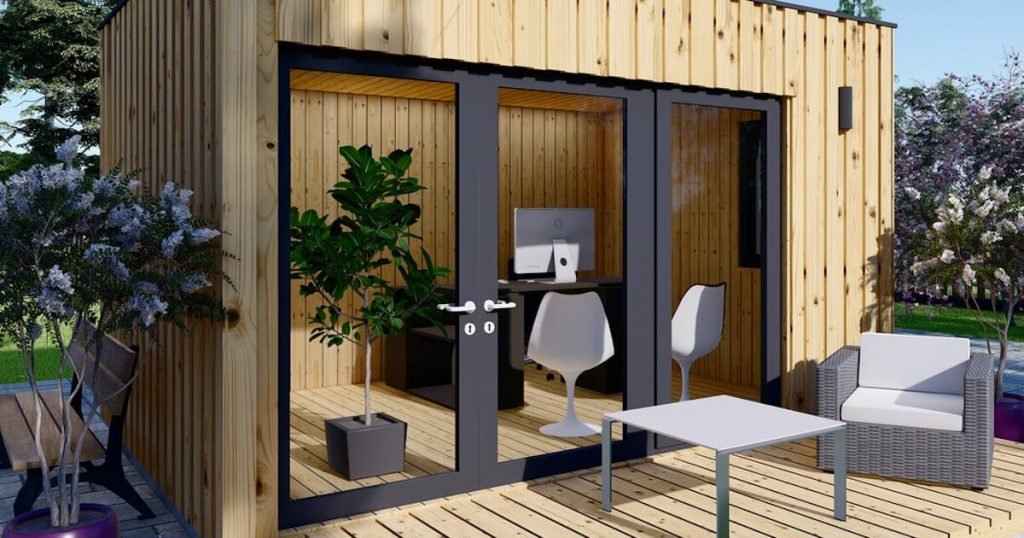
Once associated with lawnmowers and potting benches, garden buildings are undergoing a quiet transformation. Manufacturers are now offering insulated, wired, year-round office pods designed specifically for work — not hobbies.
The appeal is subtle but powerful:
- A short commute that still involves “leaving” the house
- Physical separation between work and home life
- A dedicated, distraction-free environment
- A professional backdrop for calls and client meetings
“The appeal of a garden office isn’t escape from work, but separation from the rest of life.”
For freelancers and small business owners in particular, a garden office offers something rare: legitimacy without the cost or rigidity of leased office space.
Who’s Leading the Way?
At this stage, garden offices remain the domain of early adopters. They tend to be:
- Freelancers and consultants tired of cafés and co-working spaces
- Parents seeking flexibility without sacrificing focus
- Remote employees negotiating partial home-working arrangements
- Small business owners operating from home but outgrowing it
What unites them is not lifestyle aspiration, but practicality. They are solving a problem — reclaiming time, space, and mental clarity.
“A commute of a few steps can still feel like a commute — if the boundary is intentional.”
The Commute Question
According to government transport data, the average UK commute in 2017 was close to an hour per day, with significantly longer travel times in and around major cities. This time is largely unpaid, often stressful, and widely accepted as unavoidable.
Garden offices challenge that assumption. By removing the journey without removing the separation, they offer an alternative that feels both efficient and human.
A Glimpse of What’s Next
It’s unlikely that traditional offices will disappear anytime soon. But the idea that all productive work must happen in a centralised building, five days a week, is beginning to feel outdated.
Garden offices sit at an interesting intersection:
- They support flexible working without eroding home life
- They reduce commuting without isolating workers
- They reflect a broader shift towards autonomy and trust
Whether they become mainstream or remain a niche solution is still an open question. But as flexible working continues to gain ground, the humble back garden may prove to be one of the most important new workplaces of the decade.
Sometimes the future of work isn’t a skyscraper — it’s a few steps past the patio door.
Optional Source Box (for layout)
Sources & Further Reading
- Office for National Statistics — Homeworking in the UK
- CIPD — Flexible Working Provision and Uptake
- Department for Transport — National Travel Survey
- Reporting from The Guardian, BBC Worklife, Wired UK (2016–2018)
Last updated: 9 February 2026