


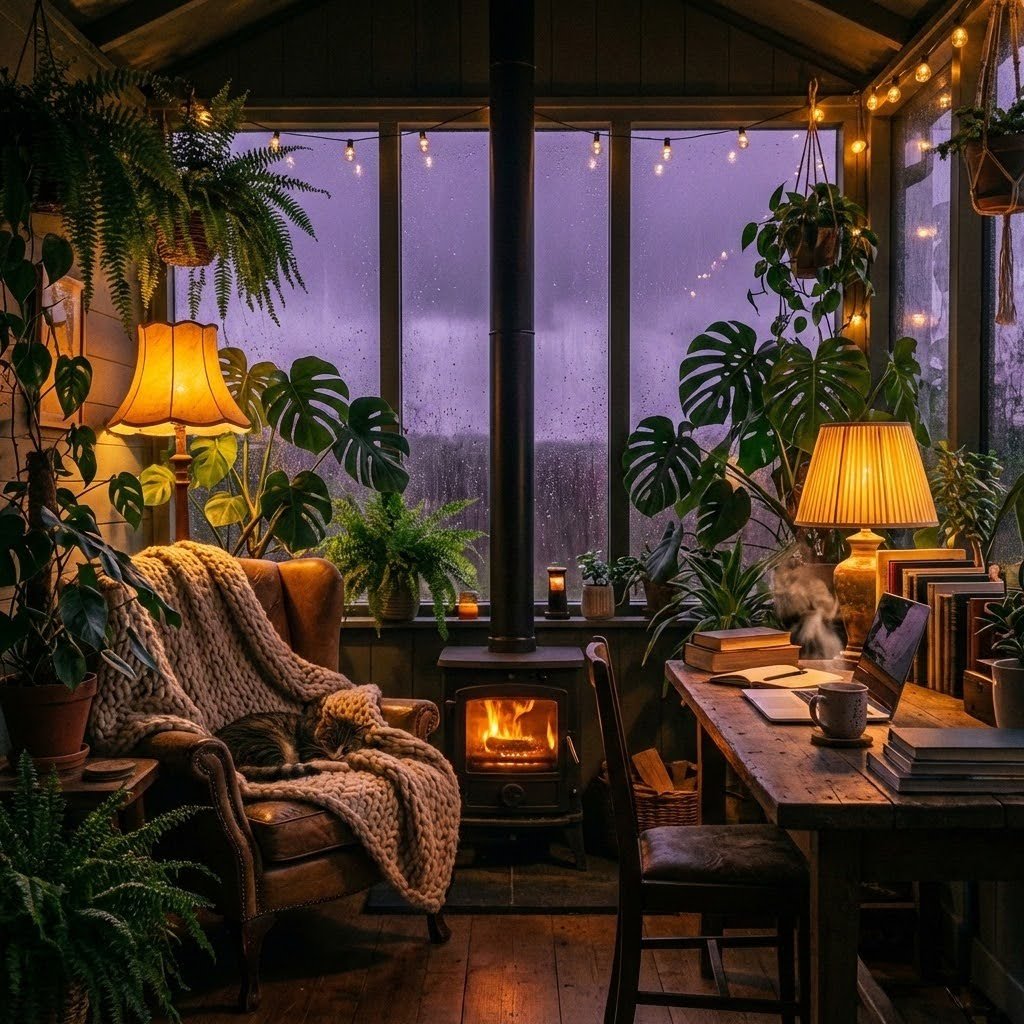
Designing for the 4 PM Fade
Date: 8 October 2025
The Autumnal Fade: Mitigating the Circadian Disconnect
October marks a critical inflection point for the home-based professional utilizing a garden office. It is the month defined by the onset of the “4 PM Fade,” a period of rapid light diminution that triggers a noticeable psychological and physiological shift. As the angle of the sun drops dramatically and the horizon-dip occurs earlier each day, the seamless psychological transition from “Productive Professional” to “Isolated Shed-Worker” can be jarring, negatively impacting end-of-day concentration and mood. This year, our focus is on implementing “Amber-Hour Lighting”—a sophisticated environmental solution that leverages high-CRI (Colour Rendering Index) LED technology to intelligently bridge the gap between diminishing natural light and the total, often stark, darkness of a typical UK winter evening. This is not merely about brightness; it is about colour temperature and spectrum continuity, ensuring the visual environment supports the brain’s circadian rhythm rather than confusing it.
The ‘Interior Forest’ Transition: Biophilia as Cognitive Anchor
The shift toward dormancy in the exterior garden creates a visual and psychological void. To counteract this, we strongly advocate for the “Interior Forest” strategy. This involves the tactical relocation of larger, hardier potted plants—such as the structural Ficus Lyrata (Fiddle Leaf Fig) or the broad-leafed Monstera Deliciosa—from the main house into the dedicated office space.
The benefits of this biophilic integration are manifold:
- Natural Humidification: As electric fan and convection heaters begin to dry the air, these plants act as natural humidifiers, improving air quality and combating the mucosal dryness often associated with prolonged indoor heating.
- Peripheral Cognitive Focus: The presence of complex natural forms in the peripheral vision has been empirically shown to maintain cognitive focus and reduce mental fatigue during low-light hours. The subtle, dynamic shadows they cast under targeted lighting add depth and richness, preventing the workspace from feeling flat and sterile.
- Aesthetic Continuity: They serve as a vital visual link to the exterior, maintaining the ‘garden’ context of the office, even when the outdoor space is bleak.
The October Wellbeing Protocol: A Three-Point Checklist for Resilience
The effective autumn office transition requires proactive measures that appeal to both the visual and tactile senses:
- Dynamic Warm-Dim Lighting: A crucial investment is in LED systems featuring a “Warm-Dim” capability. Unlike standard smart bulbs that simply reduce intensity (dimming to a cooler, less inviting light), Warm-Dim technology specifically mimics the behaviour of traditional incandescent bulbs. As they are dimmed, their colour temperature automatically shifts downward, usually from a bright 2700K to a soothing, deeply amber 2000K glow. This subtle colour change signals to the brain that the day is concluding, promoting a natural winding-down process without the harsh blue-light interference of standard lighting.
- Tactile Texture Staging: The seasonal shift should be reinforced through tactile cues. We recommend swapping light, summer-appropriate materials, such as linen or thin cotton chair-covers and throws, for high-mass textures like heavy-knit wool, bouclé, or thick velvet. This deliberate tactile change triggers a psychological response, signalling the start of the “Hygge” season—a concept of comfort and well-being—which significantly reduces the subconscious stress associated with rapidly dropping external temperatures.
- The ‘Leaf-Mould’ Ritual: Preservation and Maintenance: The most critical exterior task is the “Leaf-Mould” Ritual. Dedicate a non-negotiable 15 minutes during the lunch break to actively rake and clear wet, decaying leaves away from the perimeter and base of the office structure. Preventing the accumulation of wet biomass against the timber cladding or composite base is absolutely essential. This practice directly combats the risk of “Rising Damp” and timber rot, which can severely compromise the structural integrity and long-term air quality of the workspace.
Startup Idea: “The Light-Sync Service” – The Future of Automated Biophilic Lighting
The complexity of manually adjusting lighting to perfectly align with seasonal and daily changes presents a clear market opportunity. There is a rapidly growing business need for an “Office Lighting Designer” service, explicitly tailored to the unique micro-climates and usage patterns of garden rooms.
This service would offer a fully automated, subscription-based solution:
- Latitude-Specific Calibration: The system would be programmed to precisely counteract the specific, minute-by-minute sunset time of the user’s UK latitude and postcode.
- Predictive Ambient Shift: It would not wait for the darkness to hit, but would initiate a pre-programmed, gradual transition of the lighting temperature and intensity an hour before the onset of the “4 PM Fade,” ensuring the professional never experiences that jarring “sudden gloom” that is a notorious killer of late-afternoon productivity.
- Biophilic Integration: The service would also manage dedicated plant-growth lighting (if installed) to ensure the Interior Forest remains healthy throughout the winter months.
Conclusion: The October fade is an inevitable and predictable meteorological event. However, it does not need to be a productivity or well-being killer. By systematically treating both your internal lighting design and the inclusion of internal biophilia (plants) as forms of “mental insulation,” the garden office user can effectively buffer against the environmental shifts, successfully extending their summer energy and cognitive engagement deep into the winter working season.