

Date: 26 May 2025
The Rewilding of the Workspace: From Garden Office to Integrated Habitat
The conclusion of the RHS Chelsea Flower Show 2025 marks a pivotal shift in the architectural approach to remote working structures. The prevalent “Urban Forest” trend, which previously focused on incorporating planting around the office, has now fundamentally transformed the structure itself. This year’s “Best in Show” highlighted the concept of the “Integrated Habitat,” a design philosophy wherein the garden office ceases to be a mere dwelling in the garden and instead becomes an integral, functioning part of the local ecosystem. For the growing population of garden commuters, this represents a commitment to environmental stewardship woven directly into the daily workspace, fundamentally blurring the lines between built environment and nature.
Innovative Cladding: Introducing the “Bee-Brick” and Acoustic Wildlife Solutions
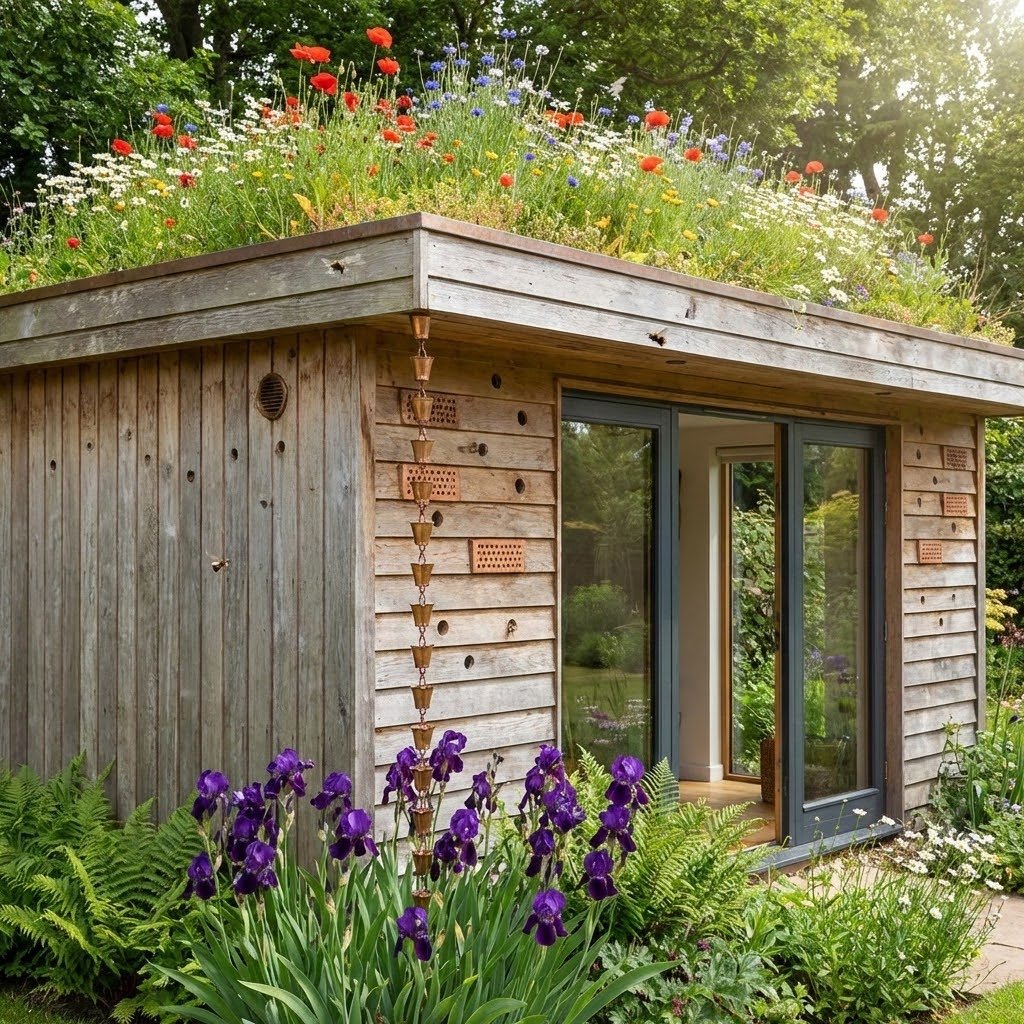
A significant technological leap demonstrated at Chelsea was the implementation of Acoustic Wildlife Cladding. This innovation addresses two critical needs simultaneously: sound reduction and biodiversity enhancement. The cladding comprises modular, interlocking cedar panels specifically engineered with integrated “nesting pockets.” These pockets are carefully lined with materials such as sustainably sourced wood-wool and clay, designed to attract and shelter essential local species, particularly solitary bees and various bat species.
Crucially, the densely packed nesting material serves a secondary, architectural function: superior sound dampening. Data from test installations suggests this cladding can reduce external ambient noise (such as lawnmowers, road traffic, and domestic activity) by up to a measurable 12dB. This provides a crucial layer of auditory privacy and calm for the occupant, all while hosting and supporting essential pollinators and pest controllers within the structure’s envelope.
The May “Rewilding” Toolkit: Mandates for a Living Office
Implementing the “Integrated Habitat” requires a practical re-evaluation of standard construction elements. The following elements are no longer optional additions but fundamental architectural mandates:
- Sedum-Plus Roofs (Wildflower Turf): Moving beyond the often-monochromatic, basic succulent green roof, the 2025 trend champions the use of “Wildflower Turf.” These specialised substrates support a biodiverse mix of native wildflowers and grasses, ensuring the roof changes colour and texture seasonally, thereby maximising aesthetic appeal and ecological value. Furthermore, these living roofs provide a quantifiable thermodynamic benefit, offering a natural cooling effect of up to 5°C during peak summer months, reducing reliance on mechanical air conditioning.
- Rain-Chain Irrigation Systems: The utilitarian plastic downpipe is obsolete. It is being replaced by elegant copper or steel Rain Chains that guide rainwater directly from the roof into bespoke “Rain Gardens.” These sunken or slightly depressed beds, strategically placed around the office base, are filled with moisture-loving native plants, such as ferns and various species of Iris. This system not only manages stormwater runoff efficiently, preventing erosion and flooding, but also creates a micro-habitat for amphibians and insects while naturally filtering pollutants.
- Night-Safe Red-Spectrum Lighting: To ensure human access after dark does not compromise the nocturnal ecosystem, standard white or blue-spectrum lighting is strictly prohibited. The mandated approach involves “Red-Spectrum” outdoor LEDs. This specific wavelength is minimally disruptive to the delicate circadian rhythms of nocturnal species, such as bats (now potentially nesting in the cladding) and owls, allowing occupants to move safely between the office and the main residence without fragmenting the nocturnal wildlife habitat.
The Profound Wellness Connection: Cognitive Recovery and Biophilia
The principles underpinning the “Biodiversity Pod” extend beyond mere ecological duty; they are intrinsically linked to occupant wellness and productivity. The “Biophilic Effect,” the innate human tendency to seek connections with nature, has moved from a theoretical concept to a measurable occupational benefit.
Data presented at the Chelsea symposium indicated that individuals working within an “Integrated Habitat” reported a 20% increase in cognitive recovery speeds following periods of intense work. This is attributed not merely to the view of nature but to the subtle, continuous interaction with the living structure.
A particularly compelling finding relates to auditory wellness: the low, consistent hum of solitary bees nesting safely within the acoustic cladding is being scientifically validated as the 2025 equivalent of “White Noise.” This natural, rhythmic sound acts as an auditory anchor, subtly masking disruptive internal and external noises. It aids concentration, reduces the feelings of isolation often associated with digital remote work, and grounds the mind in the tangible reality of the surrounding natural world. The garden office has thus evolved into a sophisticated therapeutic environment.