


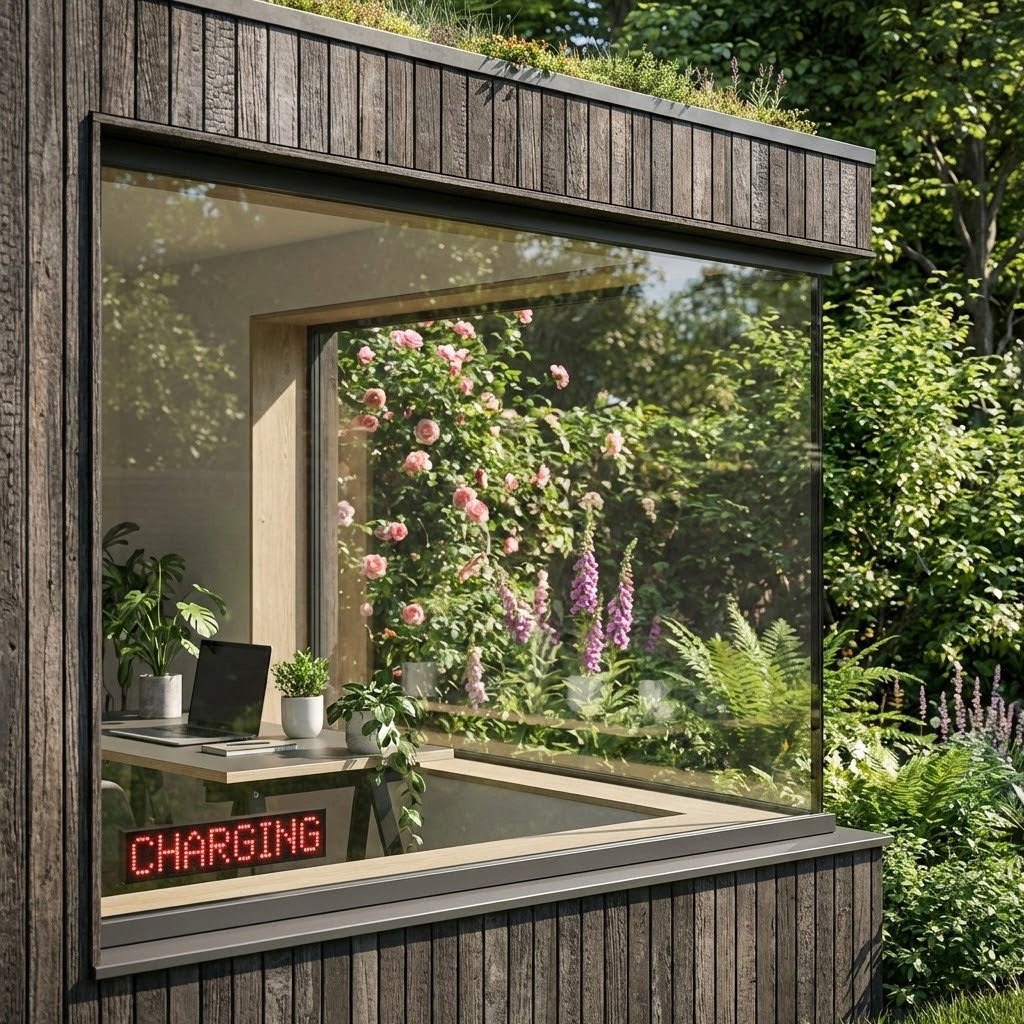
Testing the First ‘Power-Pane’ Solar Glass Windows
Date: 12 June 2025
Generating While You Gaze: The Holy Grail Finally Lands
For years, “Solar Glass” was the proverbial holy grail of green technology—a concept perpetually “five years away.” It was the ultimate promise: harnessing the sun’s energy without compromising the architectural aesthetic. In June 2025, that distant future has officially arrived for the residential and garden office market.
This month, the Garden Office Trends team embarked on a serious field test. We replaced the entire south-facing glazing of a standard 4x3m cedar office pod with the latest product to hit the market: ClearPV-Gen2 panels. These aren’t just slightly tinted windows; they are 70% transparent panes that seamlessly double as high-tech photovoltaic cells, effectively turning passive architecture into an active energy source.
The fundamental breakthrough that brought this tech from the lab bench to our garden is the successful implementation of Organic Photovoltaics (OPV). Unlike the chunky, often blue-tinted prototypes we saw back in 2023, the Gen2 panes look and feel identical to standard high-end double glazing. The difference is imperceptible to the eye, but immediately obvious on the energy meter.
Running our test in the direct, clear sunlight of a 30°C June day, the 4x3m array of Power-Panes generated a peak output of 450W of power. To put that into perspective, that single peak is more than enough to run a modern, high-spec work setup: a power-efficient M5 Mac Mini, two 27-inch 4K monitors, and an essential portable fan to keep the summer heat at bay. Crucially, even with all that running, we still had a healthy margin of change left over to trickle-charge a compact battery pack for evening use or power unexpected surges. This effectively transforms the garden office from an energy consumer into a mini power hub, dramatically reducing the reliance on the main house grid during peak daylight hours.
Deep Dive: The Technical Specifications of ClearPV-Gen2
While the visual performance is impressive, the engineering behind the ClearPV-Gen2 is equally noteworthy. It’s important to understand the trade-offs involved in achieving this level of transparency.
| Specification | Detail | Context / Notes |
| Energy Efficiency | 12% conversion rate | Low compared to opaque roof panels (which are 20-22%), but this is additive energy generation on a surface that previously generated none. The benefit is in scale and integration. |
| Transparency (VLT) | 72% Visual Light Transmittance | Excellent. This is the crucial factor that maintains the feeling of a standard, bright window. You genuinely don’t notice the difference. |
| Thermal Insulation (U-Value) | $1.1 W/m^2K$ | A U-Value of 1.1 exceeds standard UK/EU building regulations for new residential windows ($1.4 W/m^2K$). This means the insulation quality is superb, keeping heat in during winter and out during summer. |
| Connectivity | Integrated USB-C Bus | A fantastic detail: the specialized window frame, or “Power-Frame,” includes an integrated USB-C power bus, allowing you to charge laptops, phones, and accessories directly from the window frame without running extension cords or bulky converters. |
A Balanced View: Pros & Cons of Adopting Solar Glass
The technology is revolutionary, but like any new product, it comes with practical considerations regarding cost, installation, and performance variability.
| Feature | Pros | Cons | The Verdict |
| Aesthetics | The ultimate invisible green energy solution; completely eliminates the need for bulky, surface-mounted roof panels that can detract from a contemporary design. | The initial upfront cost is substantial. ClearPV-Gen2 is currently 25% more expensive than sourcing and installing standard, premium double glazing of equivalent thermal quality. | A worthwhile investment for high-end builds where design integrity is paramount. |
| Energy Generation | Offers a substantial energy offset, reliably covering 60-80% of the daily office technology power consumption during sunny periods, leading to significant savings on electricity bills. | Performance is highly variable. While peak output is great, generation drops significantly in cloudy weather or during the winter months, meaning you’ll still need grid power on standby. | Excellent for summer-heavy use, but don’t expect 24/7 self-sufficiency. |
| Heat & Comfort | The OPV layer acts as a natural, integrated light and heat filter, blocking over 90% of Infrared (IR) heat. This keeps the office naturally cooler in summer, reducing the need for costly air conditioning. | The installation is not DIY-friendly. It requires a specialized “Power-Frame” installation which houses the micro-inverters and wiring bus, adding complexity to the build phase. | The thermal benefits are a huge, often overlooked advantage, making the office more comfortable year-round. |