

The Mandate Momentum: A Cold Wind Blows on Remote Work
Date: 12 February 2024
As we enter mid-February, the subtle, patient experiment that was total remote flexibility is meeting the hard reality of corporate directives. The pendulum is swinging back. With financial giants like Barclays and technology behemoths such as Amazon forcefully tightening their “Return to Office” (RTO) mandates, the era of work-from-anywhere is unequivocally cooling. Senior leadership, often citing concerns over spontaneous collaboration and cultural cohesion, is signalling a definitive shift toward centralized work models.
However, this top-down push has met an equally determined resistance, particularly among the most coveted segments of the workforce: senior management, high-value specialists, and top-tier technical talent. This cohort, having optimized their lives around the home base, is now driving a new, potent trend: the “Garden Compromise.”
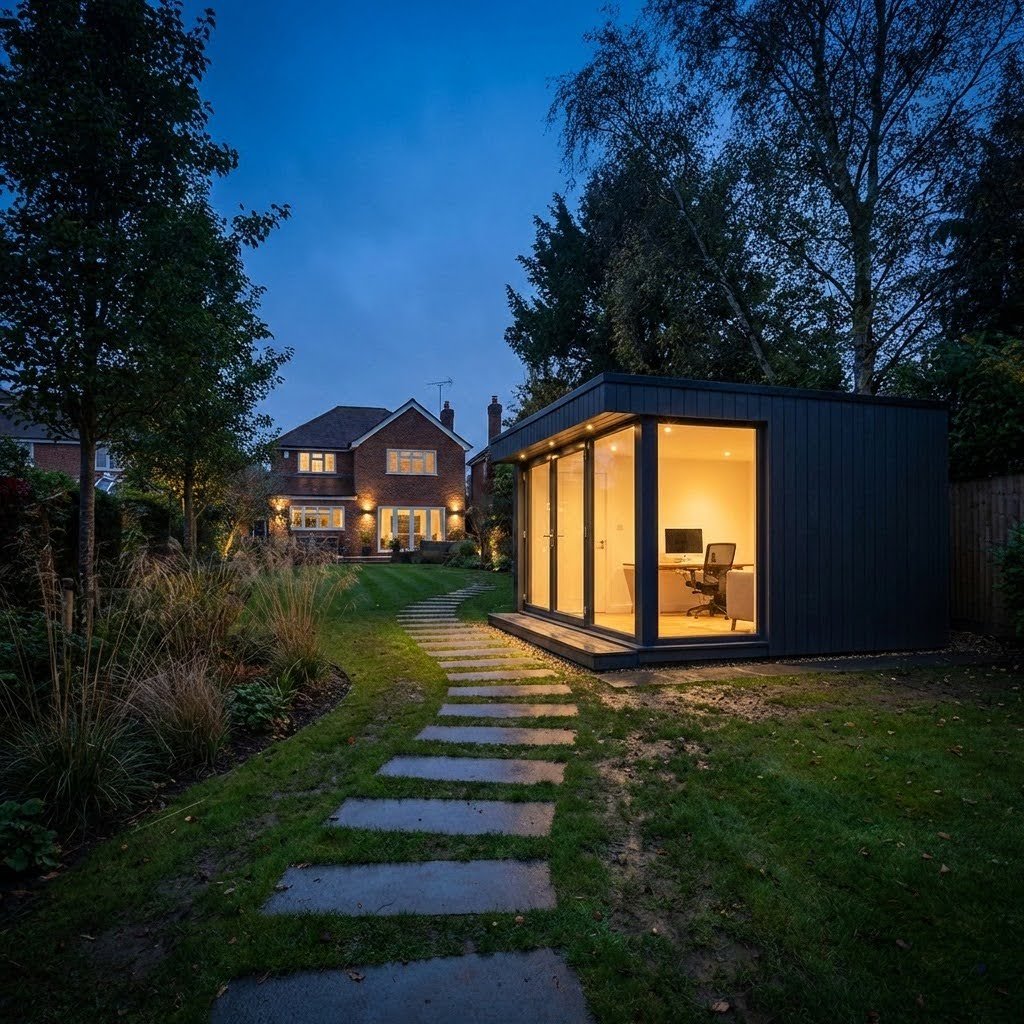
For these professionals, the garden office—or “Pod Office”—has transcended its initial role as a temporary lockdown fix. It has evolved into a fully realized “Third Space”—a professional neutral ground that successfully synthesizes the quiet, focused discipline of a corporate HQ with the unparalleled convenience of a zero-minute commute. Critically, we are observing these high-spec, standalone structures being actively integrated and explicitly cited in contract negotiations. They are no longer a personal amenity but a prerequisite for accepting hybrid roles, transforming the nature of employee-employer negotiation.
Bridging The “Professionalism” Gap: From Kitchen Table to Dedicated Facility
The core psychological and logistical complaint that fuels corporate RTO mandates is the perceived lack of a professional environment in a typical home setting. The garden office decisively resolves this issue.
A high-specification, architecturally considered garden pod completely eliminates the “kitchen table” or “spare bedroom” stigma that can erode confidence in remote work. It provides an immediate, curated, and consistent backdrop for high-stakes client calls, board meetings, and international video conferences. It signals professionalism and commitment.
From the employer’s perspective, this commitment translates into tangible benefits: it ensures the employee has a dedicated, secure, and ergonomically sound workspace. These facilities are typically fitted out with commercial-grade office furniture, proper lighting, and integrated climate control, mitigating the risk of long-term health issues and liability associated with poor home setups. Furthermore, it allows for a clear, psychological demarcation between ‘home’ and ‘work,’ a crucial element often missing in open-plan houses, thereby improving employee focus and mental health.
RTO vs. Garden Commuting: A Strategic Business Comparison
The decision between a costly RTO strategy and tacitly supporting the Garden Compromise can be framed as a clear strategic cost-benefit analysis for the modern enterprise:
| Factor | Corporate HQ (RTO) | The Garden Office (The Compromise) | Strategic Implication |
| Overhead | High (Commercial Rent, Business Rates, Facilities Management, Utilities) | Low (Residential Utility Rates, Zero Corporate Maintenance Costs) | Cost Efficiency: Significantly reduces fixed corporate real estate expenditure. |
| Culture | Direct, Spontaneous, Face-to-face (Risk of ‘Presenteeism’) | Digital-first, Intentional, High-focus (Optimized for deep work) | Productivity: Shifts focus from ‘time in office’ to measurable ‘output and impact’. |
| Security | Centralized, High-level Perimeter and IT Infrastructure | Decentralized (Hardware and Employee Policy-dependent, typically VPN-secured) | Risk Management: Requires robust IT policy for hardware encryption and physical security protocols. |
| Employee Retention | Variable (High risk of ‘Commute Burnout’ and talent exodus) | High (Optimized Work-Life balance, seen as a substantial non-monetary benefit) | Talent Acquisition: Becomes a key differentiator for attracting and retaining niche, high-demand specialists. |
| Tax & Liability | Straightforward corporate liability | Complex (Requires guidance on Business Rates, Capital Gains, and P11D implications) | Compliance: Requires clear legal and accounting framework for hybrid employment contracts. |
Strategic Advice for High-Value Negotiators
Professionals investing in a garden office must strategically frame this asset during contract negotiations to maximize its value:
- Leverage the Investment: Cease referring to your structure as a “home office.” Emphasize that it is a “Dedicated Business Facility” or a “Remote Professional Studio.” Provide photos and specifications demonstrating its high-grade fit-out, separation from the main dwelling, and dedicated access. This reframes the cost from a personal expense to a business asset.
- Reliability Metrics as Proof Points: The primary concern for remote work is connectivity failure. Proactively address this by highlighting your hardwired connectivity (e.g., Cat6 Ethernet run from the main router), dedicated fibre optic line, and any backup power solutions (e.g., UPS or small generator) as tangible proof of your “Always-On” capability and business continuity planning.
- Tax Efficiency and Legal Nuance: Consult a qualified accountant early. Explore options for reflecting the office as a tax-efficient element of your compensation package. This may involve leveraging the office as a benefit-in-kind (BIK) or classifying a portion of the structure’s running costs (utilities, maintenance) as a legitimate business expense, particularly in light of evolving hybrid contract legislation and HMRC guidelines. This financial framing solidifies its professional status.
The Psychological Boundary: Stress the pod’s role in maintaining mental health and focus. It assures the employer that the work environment is free from domestic distractions, leading to better focus and higher quality output than a blended home-work environment.
Last updated: 1 April 2026