


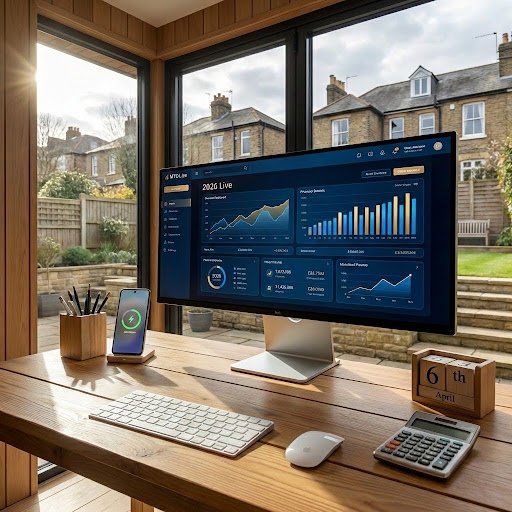
The Digital Rubicon: A New Era of Real-Time Taxation
Today, 6 April 2026, marks the most significant inflection point in the history of British taxation since the inception of Self-Assessment in 1996. For the vast population of ‘garden commuters’—those operating small- to medium-sized enterprises (SMEs) from dedicated home offices—with a qualifying gross income over £50,000, the era of the annual “January Panic” is officially over. It has been decisively replaced by the regulatory imperative of Making Tax Digital (MTD), mandating a quarterly, real-time pulse of financial reporting.
This transition is not merely an administrative shift; it is a fundamental re-engineering of the financial relationship between the business owner and His Majesty’s Revenue and Customs (HMRC). From this morning, the operational minutiae of every business transaction—every cup of coffee expensed for a client meeting, every kilowatt of electricity used to power your garden pod, and every subscription to professional software—must be digitally captured and categorized within MTD-compliant software. We are no longer simply “business owners” submitting an annual summary; we are now designated data-nodes within HMRC’s expansive, real-time financial network. While the run-up to this launch has been turbulent, characterised by last-minute software patches and compliance anxieties, the portal for the very first “Quarterly Update” is now officially open.
The ‘Final Declaration’ Reality and the Challenge of Digital Apportionment
While the quarterly updates serve as essential, legally binding snapshots of profit and loss throughout the fiscal year, the 2026/27 tax year heralds the introduction of the Final Declaration. This sophisticated new requirement effectively supersedes the traditional Self-Assessment tax return, consolidating the four quarterly submissions and any necessary year-end adjustments.
For the director or sole trader whose operational hub is based in a garden office, the principal source of complexity lies in the Digital Apportionment requirement. The classic “home as office” dilemma is now codified and automated. If your garden office is inherently “multi-use” (e.g., storing business stock alongside personal items, or dual use of utilities), your MTD software must possess the capability to dynamically and demonstrably calculate the precise business-use percentage of shared expenditures. This critical calculation now extends beyond simple rates and heating to encompass sophisticated outgoings, such as high-speed fibre-optic Wi-Fi connectivity and the maintenance costs associated with modern, bio-cladding structures (a topic extensively detailed in our March ’26 archive). The days of manually estimating percentages are over; HMRC demands a provable, digital audit trail.
“The complexity lies not in the high-level figures, but in the low-level data integrity. I’ve spent the last 48 hours providing intensive assistance to a major financial consultancy based in Edinburgh. Their main hurdle wasn’t the fundamental MTD software package itself, but the ‘Digital Link’ requirement—the critical mandate that data must flow seamlessly between different software packages (e.g., CRM to accounting ledger) without any manual intervention, specifically excluding ‘copy-and-pasting.’ This is a hard-line, zero-tolerance stance on human error that is forcing a total, non-negotiable professionalisation of the financial processes within every home-office desk.”MTD 2026: The Strategic Compliance Checklist for Q1
The success of your MTD transition hinges on the immediate adherence to three core requirements that are active now. Failure to meet these deadlines or operational standards will incur mandatory penalties.
| Requirement | Deadline | Action Required | Strategic Implication |
| First Quarterly Update | 7 August 2026 | Submit digital records for the period April 6 – July 5, 2026. This is the maiden submission under the new regime. | Establishes the initial compliance baseline. Must be a timely, digitally-generated submission. |
| Digital Links | Active Now | Ensure absolutely no manual data entry between spreadsheets and software systems. All data must flow via API, integration, or approved bridging software. | Mandates a fully automated, human-error-free audit trail for all business transactions. |
| Business Bank Sync | Active Now | Implement a direct, real-time feed from your business bank account into your MTD-compliant software. Manual reconciliation is now insufficient. | Ensures the completeness and accuracy of income data capture from the source. |
| Final Declaration | 31 January 2028 | The definitive “Year-End” summary for the 2026/27 cycle. This formally replaces the old Self-Assessment submission. | The consolidation of all four quarterly reports, finalising tax and Class 4 NIC liabilities for the year. |
Last updated: 1 April 2026