


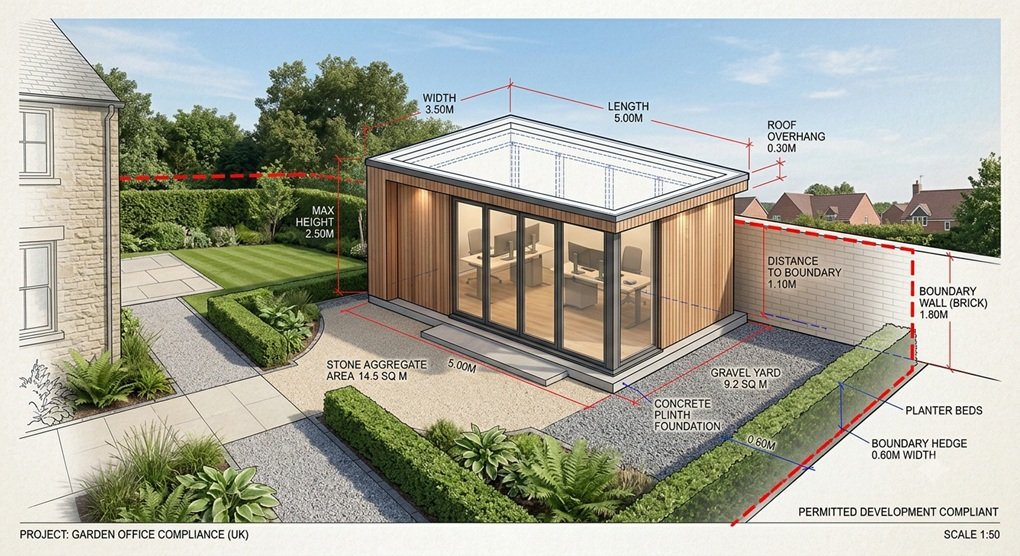
Navigating the 2026 Structural Footprint Restrictions
For the UK professional, the appeal of a garden office lies in its seamless integration—the ability to create a high-performance workspace without the bureaucratic friction of a full planning application. However, as the 2026 regulatory landscape tightens around residential footprints, maintaining compliance with Permitted Development (PD) rights has become a technical discipline in its own right.
If you are currently drafting plans for a new studio or expanding an existing one, understanding the precise, granular restrictions governing outbuildings is your first line of defense against enforcement action.
The Fundamental Boundaries of PD Compliance
Permitted Development is not a blank check. It is a strictly codified framework. For a garden office to fall under PD rights in England and Wales, it must adhere to a rigid set of dimensional and locational criteria. Straying even a few centimeters beyond these limits can void your PD status entirely.
- Eaves Height Constraints: For any outbuilding within two meters of a property boundary, the maximum eaves height is strictly capped at 2.5 meters. Exceeding this triggers a requirement for a full planning application, regardless of the building’s total size.
- Proximity to Boundaries: The 2-meter rule is the most common pitfall for garden-based directors. If your pod is positioned further than 2 meters from any boundary, you may be permitted a maximum height of 4 meters (for dual-pitched roofs) or 3 meters (for flat or single-pitched roofs).
- The Footprint Cap: The total area covered by all outbuildings—including existing sheds, greenhouses, and your new office—must not exceed 50% of the total area of land around the original house.
- ‘Original House’ Definition: Crucially, calculations are based on the house as it stood on July 1, 1948 (or when it was built, if later). Any extensions or additions built after this date count against your permitted footprint allowance.
The 2026 Nuance: Why Professional Specification Matters
In 2026, planning departments are increasingly utilizing high-resolution aerial mapping and satellite imagery to identify unauthorized residential outbuildings. Consequently, the days of “building first and asking later” are over.
Risk Factors for Modern Studios
- The ‘Integral’ Trap: Modern studios often feature integrated decking, external storage cupboards, or large, overhanging roof canopies. These are not just “design features”—they are structural additions. If your roof overhang exceeds the permitted dimensional limits, the entire structure may technically fall outside of PD rights.
- Hard Surface Limits: PD rights also cover hard surfaces (patios, paths, and decking) surrounding the building. If your garden office project includes extensive landscaping, you must ensure the total impermeable surface area does not trigger separate drainage or planning requirements.
- The ‘Primary Living Accommodation’ Clause: PD rights strictly forbid using outbuildings for primary living accommodation (e.g., as a bedroom or self-contained dwelling). If your office includes integrated plumbing for a full bathroom or sleeping quarters, local authorities may view it as a change of use rather than an ancillary workspace, which is a major compliance violation.
Actionable Protocol: Ensuring Your Studio Remains Compliant
To safeguard your garden office investment, adopt a formal documentation approach that would satisfy even the most inquisitive planning officer.
- Obtain a Lawful Development Certificate (LDC): While not strictly required for PD work, an LDC is an invaluable piece of corporate insurance. It provides formal, legal confirmation from your local council that your proposed building is permitted. Should you ever sell your property, this document eliminates any “planning risk” concerns for potential buyers.
- Document the Height ‘True North’: Always measure from the highest point of the ground level immediately adjacent to the building. If your garden is on a slope, ensure the structure’s height is measured from the highest ground level, not the lowest.
- Keep Precise Scaling Blueprints: Retain a permanent digital file containing the exact structural blueprints, site plans, and elevation drawings. If you ever face an inquiry, being able to produce professional-grade, accurately scaled documents is often the difference between a simple conversation and a formal investigation.
- Prioritize ‘Ancillary’ Design: If you are incorporating facilities like a small kitchenette or a shower, ensure they are clearly labeled on plans as ancillary to the office function, rather than suggesting the space could be used as a guest suite or separate residence.
By operating with rigorous attention to these structural and spatial constraints, you ensure that your garden office remains exactly what it is intended to be: a private, high-performance workspace protected from the uncertainties of the planning system.
Last updated: 1 June 2026