


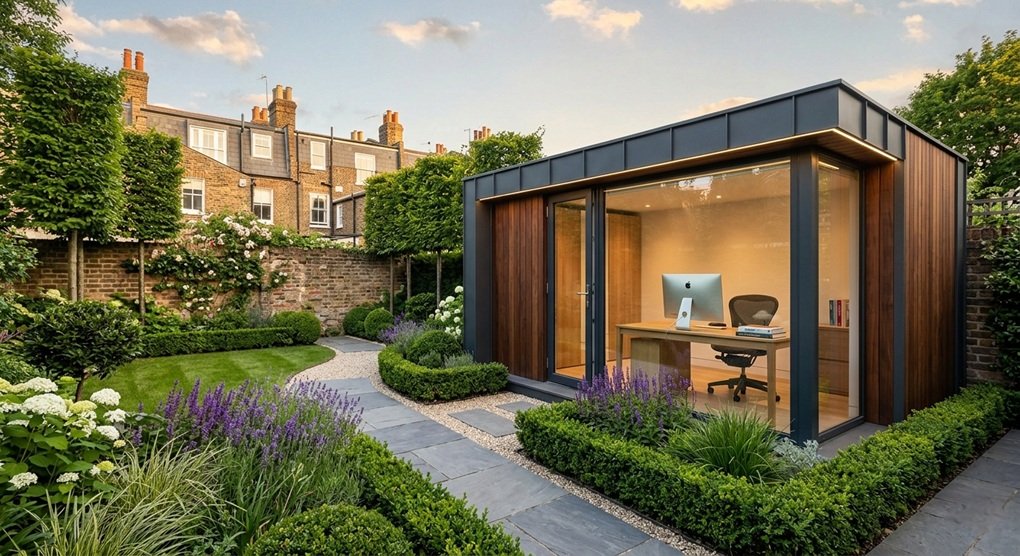
The Garden Office as a Benefit-in-Kind
In the relentless battle for top-tier talent, traditional corporate perks have lost their lustre. Free Friday beer taps and office ping-pong tables hold very little sway over senior software architects, elite consultants, or creative directors who only commute into the city once a month. The real battleground for talent retention has shifted directly to the employee’s back garden.
Forward-thinking UK firms are starting to ask an ambitious, albeit complex, question: Can we simply fund a high-end garden office for our best people to keep them from jumping ship?
While it sounds like the ultimate win-win, executing this strategy opens up a fascinating paradox with HMRC. Let’s break down the realities, the advantages, and the distinct tax traps of using a premium timber pod as a corporate retention tool.
The Core Paradox: The BIK Trap
When a company buys and installs an asset on an employee’s residential property, HMRC’s ears instantly prick up. The tax positioning hinges entirely on a single word: exclusivity.
- The Tax-Free Ideal: If a garden studio is used 100% exclusively for business, there is no Benefit-in-Kind (BIK) tax charge for the employee.
- The Reality Check: If the employee uses the space for anything else—even if it’s just a weekend hobby, a spot to watch the football, or a quiet area for the family—it triggers a BIK charge.
- The Penalty: The annual BIK calculation is hefty, typically assessed at 20% of the asset’s initial market value plus any running costs the company covers. For a luxury £30,000 cedar pod, that means a £6,000 annual taxable benefit landing squarely on the employee’s P11D.
The Corporate View: Weighing Up the Perks
For companies considering this level of investment, the strategy requires balancing exceptional human utility against some rigid tax limitations.
The Advantages
- Unmatched Employee Loyalty: Providing a custom-built, insulated cedar studio creates profound company alignment. It is a premium benefit that the employee interacts with and appreciates every single day.
- Optimised Professional Output: Upgrading a valuable asset from a chaotic kitchen table to an acoustically isolated, architecturally calm workspace pays immediate dividends in deep work and focus.
- Tax Deductions on the Fit-Out: While a company cannot claim capital allowances on the outer structural shell of a residential outbuilding, it can fully deduct 100% of the internal infrastructure under the Annual Investment Allowance (AIA). This includes heating systems, air conditioning, commercial-grade electrical wiring, and high-end ergonomic task furniture.
- VAT Reclaims: If the business is VAT-registered (and not on the Flat Rate Scheme), it can generally reclaim the VAT on both the construction materials and the interior assets, provided personal use is strictly incidental.
The Complications
- The P11D and National Insurance Hit: If HMRC determines the space is available for dual use, the employee faces a steep annual income tax bill, and the employer is hit with Class 1A National Insurance contributions on the benefit.
- The Asset Repossession Dilemma: What happens if the employee resigns six months after the pod is built? Unless the firm installs a premium, fully modular, crane-accessible pod that can be legally dismantled and relocated, the business has essentially gifted a permanent property upgrade to an ex-employee.
- The Capital Gains Tax (CGT) Sting: If the office is kept entirely exclusive for business to successfully dodge the BIK tax, the employee could face a nasty CGT bill on that specific slice of their garden when they eventually sell their home, as that footprint loses its tax-free Principal Private Residence (PPR) status.
How Savvy Companies Are Navigating the Paradox
If you are an employer looking to offer this—or an executive pitching the concept to your board—there are a few ways to structure the benefit without inviting an aggressive HMRC audit:
- Implement a Documented Usage Policy: The company must draw up a formal, signed agreement explicitly stating that the garden studio is a corporate workspace dedicated solely to business operations, with personal access strictly prohibited. This acts as your primary line of defense.
- Lean Into Movable, High-End Architecture: Avoid ground-up permanent brick-and-mortar builds. Opting for modular timber pods that can be uninstalled or moved ensures the structure remains a tangible corporate asset on the company balance sheet rather than a fixture of the land.
- The ‘Interior-Only’ Compromise: To entirely bypass structural BIK traps and CGT headaches, many companies choose not to touch the physical building. Instead, they provide a premium “Workspace Excellence Allowance”. Funding a £5,000–£10,000 interior package—covering elite sit-stand desks, Herman Miller seating, professional acoustic panelling, and enterprise-grade 6G networking—is entirely tax-efficient and entirely clean.
The Verdict
Using a garden office as a retention tool is an elite strategy that completely redefines the concept of a corporate benefit. It requires careful navigation, but when done right, it transforms a standard work-from-home routine into an executive-level powerhouse of productivity.
Last updated: 18 May 2026