


Why the Home Office Needs a Rethink
Categories: Design & Build
Tags: productivity, workspace design, focus
For all the talk of productivity tools, time-management apps, and inbox zero, one factor is often overlooked: the space in which the work actually happens.
As flexible working becomes more common across the UK, many professionals are discovering that working from home is less about freedom and more about compromise. The promise is appealing — fewer interruptions, greater autonomy, no commute — but the reality can feel oddly familiar. Distraction, discomfort, and a creeping sense that work has seeped into every corner of the house.
The problem, it seems, isn’t the work. It’s the workspace.
The Myth of “Any Desk Will Do”
In the early stages of home working, most people make do. A spare chair, a laptop balanced on the dining table, a desk squeezed into the corner of a bedroom. It works — until it doesn’t.
UK homes, particularly older or smaller properties, were never designed with full-time work in mind. Space is shared, multifunctional, and often temporary by necessity. The result is a setup that asks the brain to concentrate in places associated with eating, relaxing, or sleeping.
Focus isn’t just about discipline — it’s about environment.
This matters more than many realise. Research into workplace design has long shown that noise, lighting, posture, and visual clutter all have a measurable impact on concentration. Yet when work moves into the home, those principles are often abandoned in favour of convenience.
Open-Plan Fatigue Comes Home
Ironically, many of the problems now appearing in home offices mirror those already identified in open-plan workplaces. A lack of privacy. Constant low-level interruption. The feeling of being “on” at all times.
At home, the interruptions are simply different: deliveries, household noise, family members passing through shared spaces. Even when no one else is present, the visual reminders of domestic life can make it harder to enter a focused state.
There’s also the issue of boundaries — or the lack of them.
Without a clear physical separation between work and home, many people report difficulty switching off at the end of the day. The laptop stays open a little longer. Emails are checked later into the evening. Work expands to fill the space available.
Why Design Is About Behaviour, Not Just Looks
Good workspace design isn’t about creating something Instagram-ready. It’s about supporting specific behaviours: focus, clarity, and sustained attention.
In practical terms, that often means:
- A consistent, dedicated place to work
- Natural light without excessive distraction
- Proper desk height and seating
- Storage that keeps work contained, not scattered
Small details matter more than square footage. Even modest spaces can support deep work if they are designed with intention rather than compromise.
When a space signals “this is where work happens”, the mind tends to follow.
The Case for Separation
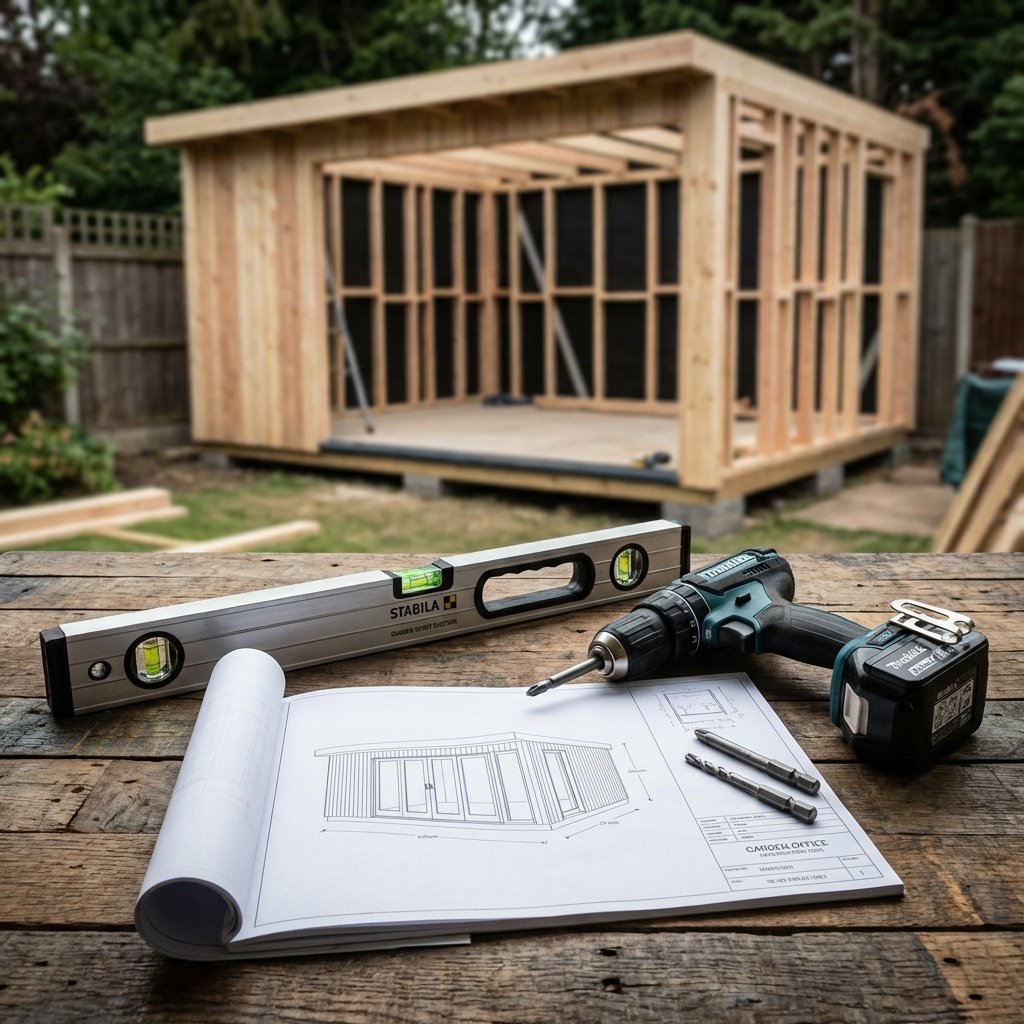
This is where interest in garden offices and purpose-built workspaces begins to make sense. Not as a luxury, but as a design response to a real problem.
By creating physical distance — even a few metres — people introduce a psychological shift. The act of leaving the house, closing a door, and entering a space designed solely for work provides structure that spare rooms and shared areas struggle to replicate.
For many UK workers, particularly freelancers and remote employees, this separation offers:
- Fewer interruptions
- Clearer start and end points to the day
- Improved posture and comfort
- A stronger sense of professionalism
It’s not about isolation. It’s about clarity.
Designing for the Way We Actually Work
As flexible working continues to evolve, the home office can no longer be an afterthought. It needs to be treated as a functional environment with specific demands — just like any other workplace.
That doesn’t mean every home requires an extension or a purpose-built office. But it does mean acknowledging that focus is fragile, and design plays a bigger role in protecting it than most of us were taught to believe.
Productivity doesn’t start with software. It starts with space.
The question isn’t whether home working will continue — it almost certainly will. The real question is whether our homes, and the spaces we carve out within them, are ready to support the way we now ask ourselves to work.
Last updated: 9 February 2026