


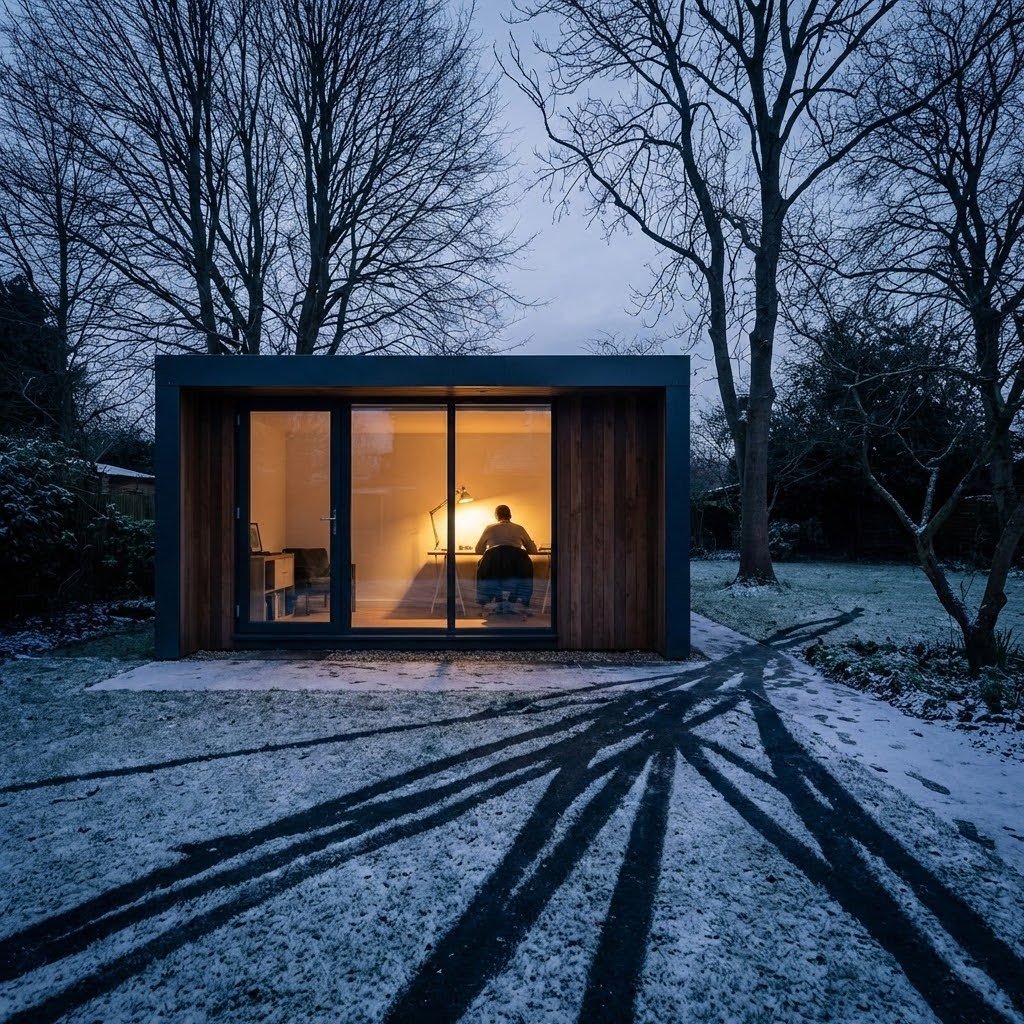
The Architecture of Dormancy: December as the Diagnostic Month
December, traditionally viewed as a period of cessation in the garden, must be redefined as the most critical month for Diagnostic Environmental Design. It is not a time for active horticulture, but rather a mandatory period for Shadow-Mapping and the comprehensive assessment of the garden office’s microclimate. With the seasonal loss of foliage and the sun traversing its lowest, most oblique winter arc, your structure is laid bare, existing in its most “naked” and revealing state. This moment of vulnerability allows the environmental designer to observe the “Deciduous Framework”—the precise, skeletal structure of the surrounding trees—and to plot the exact, unwavering path of the winter sun against the office’s physical envelope.
This exposure reveals inherent inefficiencies. The design philosophy for the 2026 working year must therefore be one of precision: “Silhouette Planning.” This methodology necessitates detailed observation of how shadows, particularly those cast by surrounding infrastructure and established flora, interact with your office’s glazing. By systematically recording the length, density, and trajectory of these shadows at two strategic points—11:00 AM (the peak solar heating moment) and 2:00 PM (the post-meridian decline)—in the depth of winter, we can derive the essential data required for targeted planting. This data directly informs the strategic placement of “Thermal Screens” (dense evergreens like Holly or Yew, used to intercept prevailing winter winds) and the definition of “Solar Windows” (intentional gaps or clearings) designed to maximize vital natural heat gain through Passive Solar Acquisition.
The December “Shadow-Map” Protocol: A Three-Point Audit for 2026 Efficiency
The following protocol is a structured, three-step audit that transforms subjective observation into objective design strategy, ensuring the garden office functions as a highly tuned component of a larger “Living Machine” in the new year.
1. Solar Tracking and Passive Deciduous Management
The primary objective is the precise identification of areas that receive maximum, direct solar penetration during the winter months. This can be achieved through technical means (a time-lapse camera focused on the south-facing elevation) or practical methods (a simple sun-path application and manual notation). Crucially, these specific sun-drenched zones should be designated for the future planting of deciduous trees. This strategy leverages the natural life cycle of the chosen species: during the summer, when cooling is essential, their canopy provides dense, vital shade; conversely, in the winter, once the leaves have fallen, the resulting bare structure allows for unobstructed “Passive Solar Gain,” minimizing the reliance on artificial heating. This is a fundamental principle of sustainable, four-season office design.
2. The “Wind-Tunnel” and Thermal Sink Audit
A detailed examination of the office walls and surrounding ground must be conducted to identify “Thermal Sinks”—areas where heat loss is maximized due to relentless wind exposure or persistent dampness. The tell-tale sign of a thermal sink is the prolonged lingering of frost or dew on the exterior walls, often remaining long after surrounding areas have thawed. These points indicate a need for immediate intervention via a biological windbreak. We recommend planning for the installation of robust, cold-hardy evergreens in these specific locations during the early spring (March). Prime candidates for this living structural defense include Yew (Taxus baccata)—known for its density and longevity—and various cultivars of Holly (Ilex), which provide significant year-round screening and structural integrity against prevailing winds.
3. Bark-Scaping: Enhancing the Aesthetics of the Winter Working Day
Beyond the functional considerations of heat and wind, the winter garden office requires a strategic focus on visual and psychological warmth, particularly during the early darkness of the 4:00 PM fade.
Bark-Scaping is the specialized design element that addresses this. It involves the deliberate placement of specific specimen trees chosen for the high aesthetic quality of their bark structure. When illuminated by the subtle, upward-angled light of exterior garden office floodlights, the peeling, high-contrast bark of species such as the Paperbark Maple (Acer griseum) or the rich, glossy, mahogany-toned bark of the Tibetan Cherry (Prunus serrula) provides a sophisticated and vital focal point. This architectural approach to planting transforms a potentially desolate winter view into a curated, glowing landscape, enhancing the employee experience as dusk falls.
The End of Year Conclusion: From Survival to Sophistication
The modern garden office must transcend its original function as a mere isolated shelter. As we look ahead to 2026, the structure must be integrated into a functional, highly-tuned “Living Machine”—a workspace whose operational efficiency is intrinsically linked to the surrounding climate, the local flora, and the broader corporate infrastructure of the United Kingdom. The era of improvisational construction is concluded. The mandate now is a move from “survival” (an ad-hoc solution to the pandemic) to “sophistication” (a scientifically and aesthetically informed design that optimizes for all four seasons). The deliberate, analytical process of December’s Shadow-Mapping forms the intellectual blueprint for this transition.